
Scott Edelman
  • Home
  • Blog
  • About
  • Writing
    • Short Fiction
    • Books
    • Comic Books
    • Television
    • Miscellaneous
  • Editing
  • Podcast
  • Contact
  • Videos

©2026 Scott Edelman

Wondering about Sense of Wonder

Posted by: Scott    Tags:  Michael Chabon    Posted date:  February 5, 2008  |  No comment


In an essay at the back of the new edition of The Mysteries of Pittsburgh, Michael Chabon shares some of the motivations his then twenty-two-year-old self had in approaching the book. He writes of how even literature with no fantastic elements should offer the same sense of wonder delivered by science fiction:

I wanted to tell stories, the kind with set pieces, and long descriptive passages, and “round” characters, and beginnings and middles and ends. And I wanted to instill—or rather I didn’t want to lose—that quality, inherent in the best science fiction, which was sometimes called “the sense of wonder.” If my subject matter couldn’t do it—if I wasn’t writing about people who sailed through neutron stars or harnessed suns together—then it was going to fall to my sentences themselves to open up the heads of my readers and decant into them enough crackling plasma to light up their eye sockets for a week. But I didn’t want to write science fiction, or a version of science fiction, some kind of pieced-and-tattooed, doctorate-holding, ironical stepchild of science fiction. I wanted to write something with reach. Welty and Faulkner started and ended in small towns in Mississippi but somehow managed to plant flags at the end of time and in the minds of readers around the world. A good science fiction novel appeared to have an infinite reach—it could take you to the place where the universe bent back on itself—but somehow, in the end, it ended up being the shared passion of just you and that guy at the Record Graveyard on Forbes Avenue who was really into Hawkwind. I wasn’t considering any actual, numerical readership here—I wasn’t so bold. Rather I was thinking about the set of axioms that speculative fiction assumed, and how it was a set that seemed to narrow and refine and program its audience, like a protein that coded for a certain suite of traits. Most science fiction seemed to be written for people who already liked science fiction; I wanted to write stories for anyone, anywhere, living at any time in the history of the world. (Twenty-two, I was twenty-two!)

I was thinking pretty much the same thing recently while exchanging e-mails with someone about Kurt Vonnegut’s short-story collection Welcome to the Monkey House. I had forgotten how many of the stories in the book were not science fiction, and I think this was because even those stories without SF elements—such as “Who Am I This Time?,” about a man who shed his shyness when acting in community theater—always seemed to have that SF flavor to me.

And to take it a step further, not only is there much purportedly mainstream fiction which contains enough sense of wonder to have that SF feel, there’s also inversely plenty of science fiction so devoid of sense of wonder as to appear mainstream. (Though I do wish that there was a better descriptive term, as I’ve never cared for mainstream, mimetic, or mundane.)

Perhaps when I have the time someday, I’ll plot a graph, with the X-axis representing whether a work announces itself as science-fictional or not, and the Y-axis representing what each actually feels like.

D.C. yesterday, Denver tomorrow

Posted by: Scott    Tags:  Paul Levitz, Worldcon    Posted date:  February 4, 2008  |  No comment


Like many of you, I’m currently making plans to attend Denvention 3, the 66th World Science Fiction Convention, to be held later this year in Denver. Looking ahead to yet another WorldCon brings back memories of my first WorldCon, Discon II, the 32nd World Science Fiction Convention, held in Washington, D.C. back in 1974.

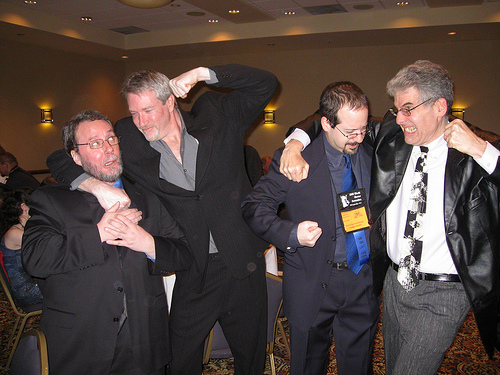
DCWorldconPhotocopy

I was still living in Brooklyn with my parents at the time, and drove down in a van with a group of other fans. Here’s the only photographic evidence of that trip. The image is fairly faded by now, because I don’t have an original print, only a poor photocopy. (Click above to see a larger version of these four sorry mugs.) This photo was snapped on a day we stole away from the con for a few hours to play tourists. We’re sitting in front of the fence that surrounds the White House.

Who are these four stooges? See No Evil is comic-book colorist Carl Gafford. Speak No Evil is Paul Levitz, then just a green employee at DC Comics, the company for which he is now Publisher. Hear No Evil is Steve Gilary, a fellow comic-book fan. And as for me at the far right, well … by the placement of my hands, I guess my role is Do No Evil. So while my hair may have changed with the years, my habit of hamming it up for the camera has remained consistent.

It was a great first WorldCon, and if I ever find the clipping of the article I wrote about the experience for the Brooklyn College student newspaper, I’ll upload that as well.

It’s Itzkoff, alas

Posted by: Scott    Tags:  Bill Hader, David Itzkoff, R.A. Lafferty    Posted date:  February 3, 2008  |  No comment


Dave Itzkoff is blathering again in the pages of the New York Times, once more demonstrating himself to be a critiquer of a field for which he feels only embarrassment. It’s as if the newspaper has, after a long search, managed to select the anti-Michael Dirda as its regular SF reviewer.

DavidItzkoff

There are times that I almost wish that the New York Times didn’t cover SF at all rather than have Itzkoff covering it, because I don’t like having to wince several times whenever I read each of his columns. Today, for example, while praising two YA novels, he actually begins by slamming the entire genre:

I sometimes wonder how any self-respecting author of speculative fiction can find fulfillment in writing novels for young readers. I suppose J. K. Rowling could give me 1.12 billion reasons in favor of it: get your formula just right and you can enjoy worldwide sales, film and television options, vibrating-toy-broom licensing fees, Chinese-language bootlegs of your work, a kind of limited immortality (L. Frank Baum who?) and—finally—genuine grown-up readers. But where’s the artistic satisfaction? Where’s the dignity?

Where’s the artistic satisfaction, Dave? Where’s the dignity? (more…)

A lack of Candorville at the Washington Post

Posted by: Scott    Tags:  censorship, comics    Posted date:  February 1, 2008  |  No comment


It was revealed in this week’s online chat with Washington Post columnist Gene Weingarten that the paper refused to publish the January 19 installment of the comic strip Candorville.

Here it is for those of you in the DC area who had to settle for a replacement that day. (Click to see the strip at a more readable size.) I have no idea whether any other newspapers took the same action.

Candorville

Participants in the chat took both sides, with a few mentioning that different versions of the joke had been made previously by comedians Dick Gregory and Dave Chapelle.

Touched by human hands

Posted by: Scott    Tags:  Robert Sheckley    Posted date:  January 31, 2008  |  No comment


I’ve been looking back at Robert Sheckley’s first short-story collection, Untouched by Human Hands. It was published in 1954, when Sheckley would have been 26 (or maybe only 25, depending on what part of the year the book came out). It includes his classic story “The Monsters,” originally published in F&SF, which I like to reread every couple of years.

RobertSheckley

But what attracted my attention the most this time was his biographical blurb from the last page, which listed his previous jobs from his first quarter century as: (more…)

Magazine publishing circa 1893

Posted by: Scott    Tags:  old magazines, The Cosmopolitan    Posted date:  January 28, 2008  |  No comment


It’s said that the two things you should never see being made are sausages and the law, but to that list you should add magazines. It can be an ugly process. And yet the editors of The Cosmopolitan, one of the leading general-interest magazines in the country, decided to share their secrets with a lengthy article in the January issue.

Cosmopolitan1893

That’s the January 1893 issue, as you can see by my somewhat tattered copy.

In an article titled “The Making of an Illustrated Magazine,” readers are taken through the entire publishing process, from start-up costs, to the difficulties of obtaining advertising, to that stack of unsolicited manuscripts that has existed at every magazine since the first issue of the first magazine was carved into stone tablets.

Here are a few choice excerpts from that 14-page article, which show that perhaps time really hasn’t changed things that much after all. (more…)

Winnie the Po—OOOWW!!

Posted by: Scott    Tags:  Winnie the Pooh    Posted date:  January 28, 2008  |  No comment


The latest cover of the Belgian magazine Humo—which I’d never heard of before but which my poor translation skills cause me to believe is a cross between the National Lampoon and Spy—has caught the attention of Walt Disney’s army of lawyers, which is never a good thing. (Just ask Dan O’Neill and the Air Pirates.)

WinnieHumo

The cover, by the artist Jeroom, features Winnie the Pooh bludgeoning Piglet with a hammer while Eeyore and Tigger watch on. The image is supposedly illustrating a story on near-death experiences. (Though, if you ask me, if anyone deserves to get bludgeoned to death with a hammer, it’s that Eeyore, who as far as I’m concerned has been asking for it for years.)

Disney’s lawyers are supposedly investigating their options, while Humo is defending its actions as parody. Here in the U.S., the claim of satire would certainly protect Humo, but I have no idea whether that’s considered a sufficient defense internationally.

I’m assuming that the magazine is on solid ground, but is there anyone out there with a better understanding of international trademark and copyright law who can give a definitive answer?

Tastes like chicken

Posted by: Scott    Tags:      Posted date:  January 27, 2008  |  No comment


If you have a hankering for guinea pig, and don’t know quite where to satisfy that hunger, hop on a plane to Quito, Ecuador and pay a visit to the Wasi Cuy restaurant, which translates as House of Guinea Pig.

Guinea pig is a traditional Ecuadorean dish, though not one of which all Ecuadoreans seemed to be enamored, at least not based on the response we got when we tried to track some down several years ago in Guayaquil and the Galapagos Islands. “Only those crazy mountain people eat that,” we were told, and so we had to wait until we were in those mountains, visiting the Ecuadorean capitol.

The concierge at the hotel sent us off to Wasi Cuy, reputed to serve the best cuy in the city. If you click to enlarge the flier we were given, you’ll see cuy as it is traditionally served, in a single deep-fried portion. The animal may have been gutted, but its head—teeth and whiskers intact—was still attached, so it eyed us suspiciously throughout the meal.

I sadly report that the meat did indeed taste like chicken, so the experience did not introduce me to a new taste sensation. But it was an interesting restaurant, filled with paintings of happy, laughing guinea pigs wearing traditional Ecuadorian garb. They appeared ignorant of their fate as they watched us dispatching their unfortunate cousin.

Irene and I were there back in 2001, but according to this site, it appears to still be in business. So if you’re in the mood … now you know where to go!

The typing is the blog

Posted by: Scott    Tags:  Esquire, Nick Flynn    Posted date:  January 26, 2008  |  No comment


Nick Flynn just published an interesting article titled “The Ticking is the Bomb: A Memoir of Torture” in the February 2008 issue of Esquire. On the one hand, the piece is exactly what the subhead describes it as, a story about the author’s trip to Istanbul to listen to accounts of torture from former prisoners at Abu Ghraib. But the essay does its job is a very rambling way, offering poetic asides about memories, perceptions, families, and dreams.

In one section, Flynn describes his meditation retreat with a Vietnamese Zen master:

Thich Nhat Hahn says it is a mistake to say, “The rain is falling,” to say, “The wind is blowing.” What is rain if it is not falling? he asks. What is wind if it is not blowing? The falling is the rain, the blowing is the wind.

This passage had nothing to do with writing; it was meant to speak to the impermanence of our existence. But it also gave me a little “Aha!” moment. Have I been guilty of writing a sentence in which the wind blew? Did I ever say that the rain was falling? Was there really a need to say so? What else would they be doing? Wind blows. Rain falls. And words can be redundant.

It reminded me of the need to prune my prose. Not something I always do wisely here … but you know what I mean.

Perhaps that’s an inconsequential and insulting moral to take from such a horrifying essay, but I’m a writer. I commit such crimes all the time.

Everything’s not relative

Posted by: Scott    Tags:  Herb Edelman    Posted date:  January 24, 2008  |  No comment


People ask me from time to time whether I’m related to Ric Edelman, the financial guru who writes books and hosts a radio show. But no, I’m not.

They also occasionally ask whether I’m related to Daniel J. Edelman, founder of the PR firm that bears his name. Nope, no relationship there either.

When I’m in the UK, I sometimes get asked whether I’m related to Keith Edelman, formerly General Manager and currently President of Arsenal Football. Though we’ve met, and have joked about being cousins, we’re not.

And then a couple of times I’ve been asked whether I’m related to Randy Edelman, film composer for Dragonheart and the current 27 Dresses, but whose true claim to fame as far as I’m concerned is that he wrote the theme to MacGyver. No blood there either.

This is the Edelman to whom I’m related. And strangely, he’s also the one famous Edelman about whom no one’s ever asked.

‹ Newest 345 346 347 348 349 350 351 352 353 354 Oldest ›
  • Follow Scott


  • Recent Tweets

    • Waiting for Twitter... Once Twitter is ready they will display my Tweets again.
  • Latest Photos


  • Search

  • Tags

    anniversary Balticon birthdays Bryan Voltaggio Capclave comics Cons context-free comic book panel conventions DC Comics dreams Eating the Fantastic food garden horror Irene Vartanoff Len Wein Man v. Food Marie Severin Marvel Comics My Father my writing Nebula Awards Next restaurant obituaries old magazines Paris Review Readercon rejection slips San Diego Comic-Con Scarecrow science fiction Science Fiction Age Sharon Moody Stan Lee Stoker Awards StokerCon Superman ukulele Video Why Not Say What Happened Worldcon World Fantasy Convention World Horror Convention zombies