
Scott Edelman
  • Home
  • Blog
  • About
  • Writing
    • Short Fiction
    • Books
    • Comic Books
    • Television
    • Miscellaneous
  • Editing
  • Podcast
  • Contact
  • Videos

©2026 Scott Edelman

Congratulations, Marie Severin!

Posted by: Scott    Tags:  Marie Severin    Posted date:  February 8, 2008  |  No comment


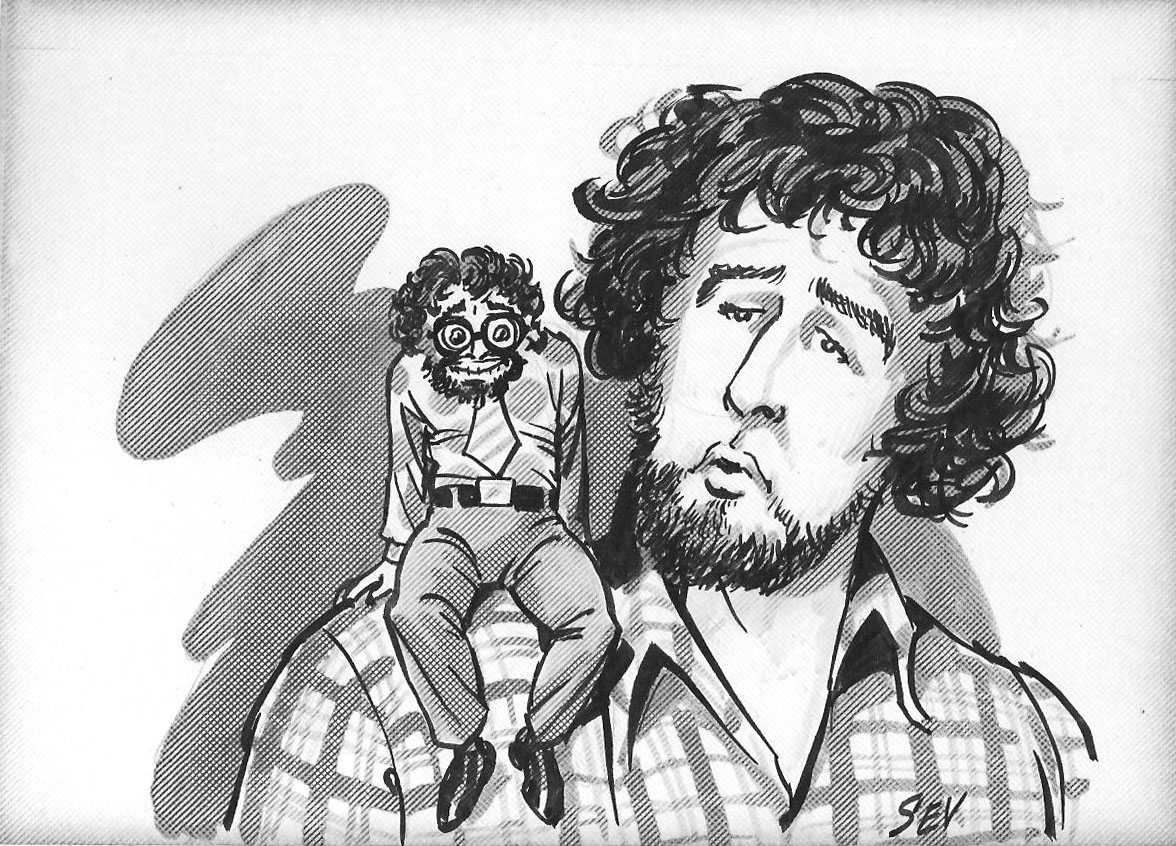
As many of you have probably already read elsewhere, national treasure Marie Severin has been recovering from her recent stroke, and now that her health has improved, she’s just moved into an assisted living facility. All of us who love her look forward to her continuing with that recovery.

MarieIsabellaMe

In addition to Marie quite possibly being the nicest person to have ever worked in the comics industry, she is also one of the funniest and most talented people I know.

Now, this might seem a rather strange and silly comparison, but back when I started working at the insane zoo that was the Marvel Comics of the ’70s, the wild and woolly Bullpen actually seemed like the Alan Brady Show to me (that fictional show within the Dick Van Dyke Show, remember?), and Marie was our Sally Rogers, the sassy wisecracking dame (a term I don’t think she would find objectionable) who always spoke her mind. She was one of the reasons it was so much fun to go to work each day at 575 Madison Avenue.

Marie is famous not only for her hilarious personality, addictive art style, and nuanced coloring, but also for her caricatures, going all the way back to her EC days. During my years on staff at Marvel, I was lucky enough to have had her draw my mug a number of times. (more…)

Just what the doctors ordered

Posted by: Scott    Tags:  old magazines    Posted date:  February 8, 2008  |  No comment


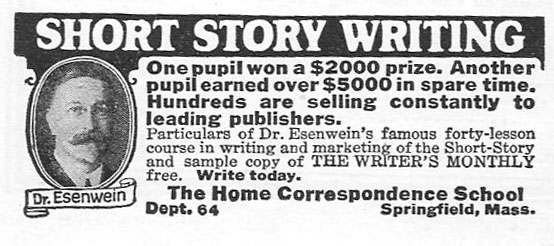
Writers! Are your short stories sick? Are you looking for a cure to all of your writing afflictions? Seek no further, for two doctors have the prescription for your many fiction ills.

DrEsenweinHomeSchoolAd

Plucked from the pages of the April 1929 issue of Scribner’s magazine are advertisements from two doctors who are willing to show you the way to healthy prose.

First up is Dr. Esenwein, who hopes that you’ll enroll in his correspondence course in the writing and marketing of short stories. I’d never heard of Esenwein, and had no idea of the validity of his claim to be able to train his students to the point where they’d amass the talents to earn $5,000 (in 1929 dollars) in their spare time, so I figured I’d better check his credentials. A quick online search reveals Dr. Esenwein to be J. Berg Esenwein, the editor of Lippincott’s magazine and the author of the 1908 textbook Writing the Short-Story: A Practical Handbook on the Rise, Structure, Writing and Sale of the Modern Short-Story. I see that Dr. Esenwein operated out of Burlington, Massachusetts, so we now know the real reason why ReaderCon has chosen that city as its home! (more…)

The Sound and the Fury

Posted by: Scott    Tags:  old magazines    Posted date:  February 7, 2008  |  No comment


Singing in the Rain has always been one of my favorite movies, and not just because of the talented stars and amazing songs (though, of course, that’s the major reason). But I think some small part of the film’s intrigue is because it’s one of the few films detailing the painful transition as one art form supplants another. I don’t see that sort of picture happening again any time soon. I mean, how likely is it that someone’s going to write a movie musical someday about the current battle between paper books and e-books?

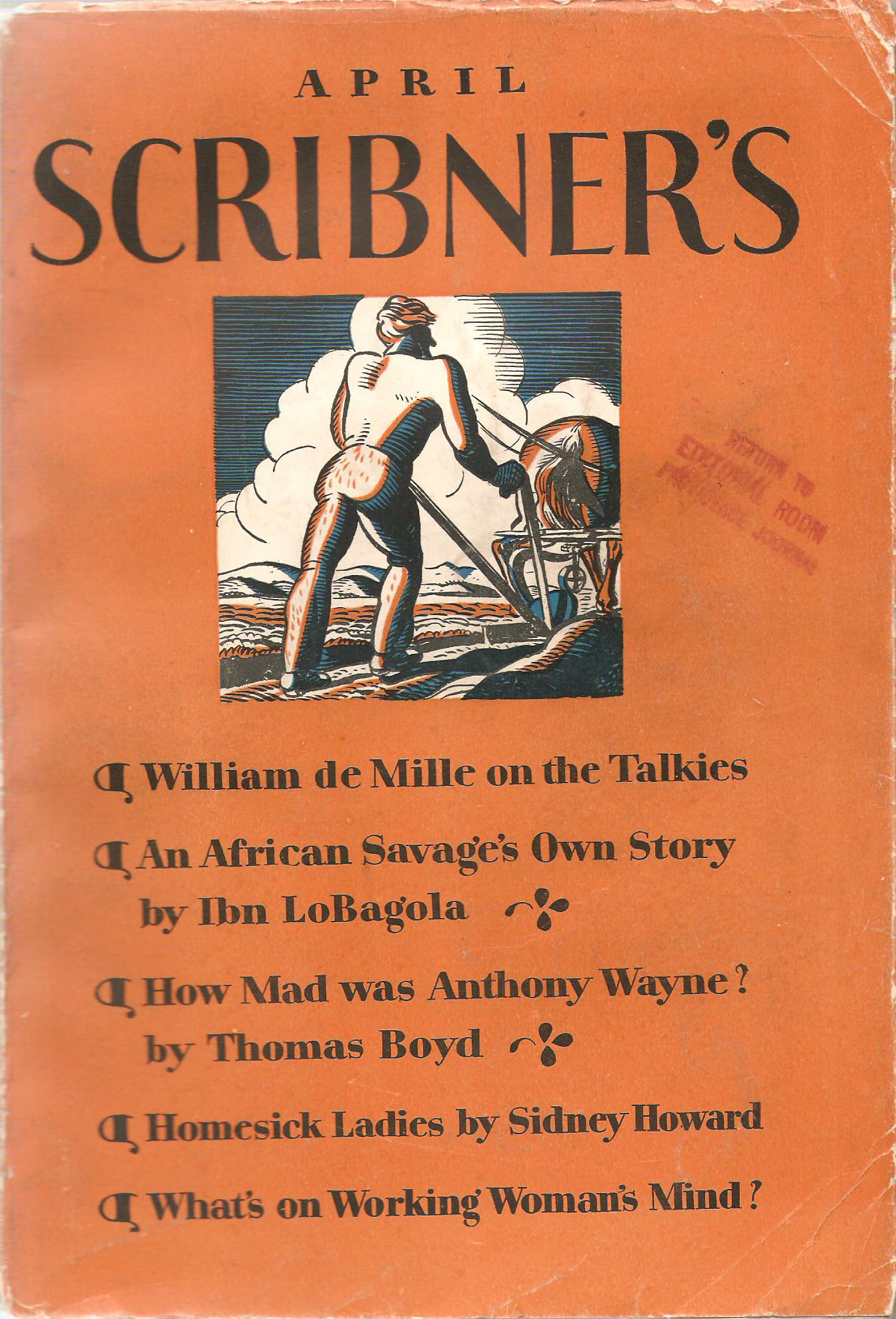
ScribnersApril1929Cover

Singing in the Rain told the story of the Talkies taking over the screen from a distance of 1952. But what did people think at the time it was actually happening? An article in the April 1929 issue of Scribner’s gives some clues. To lay out the time frame, The Jazz Singer, starring Al Jolson, premiered on October 6, 1927, at least in the big cities, though it took around six months to be seen by the rest of the country. Based on that, and on the lead time the magazine would have required, the essay “The Screen Speaks” by William de Mille would have been written during that first uncertain year.

William de Mille was the older brother of Cecil B. DeMille and father to Agnes de Mille. He was a silent film writer, director, and producer who, according to the editorial note at the beginning of the article, “says that he will probably never direct another silent film.” So his insight into the shift is invaluable. (more…)

Them’s writin’ words

Posted by: Scott    Tags:  Ursula K. Le Guin    Posted date:  February 6, 2008  |  No comment


Somewhere on LiveJournal—or maybe it was over on the Asimov’s board—there was a recent thread about style versus substance, which contained the usual long debate about which of the two was more important. I can no longer find where that conversation was going on, so I’ll just post here what I’ve always though of as the final word on the subject, from Ursula K. Le Guin’s classic 1973 essay “From Elfland to Poughkeepsie”:

Many readers, many critics, and most editors speak of style as if it were an ingredient of a book, like sugar in a cake, or something added onto the book, like the frosting on the cake. The style, of course, is the book. If you remove the cake, all you have left is the recipe. If you remove the style, all you have left is the synopsis of the plot.

Wondering about Sense of Wonder

Posted by: Scott    Tags:  Michael Chabon    Posted date:  February 5, 2008  |  No comment


In an essay at the back of the new edition of The Mysteries of Pittsburgh, Michael Chabon shares some of the motivations his then twenty-two-year-old self had in approaching the book. He writes of how even literature with no fantastic elements should offer the same sense of wonder delivered by science fiction:

I wanted to tell stories, the kind with set pieces, and long descriptive passages, and “round” characters, and beginnings and middles and ends. And I wanted to instill—or rather I didn’t want to lose—that quality, inherent in the best science fiction, which was sometimes called “the sense of wonder.” If my subject matter couldn’t do it—if I wasn’t writing about people who sailed through neutron stars or harnessed suns together—then it was going to fall to my sentences themselves to open up the heads of my readers and decant into them enough crackling plasma to light up their eye sockets for a week. But I didn’t want to write science fiction, or a version of science fiction, some kind of pieced-and-tattooed, doctorate-holding, ironical stepchild of science fiction. I wanted to write something with reach. Welty and Faulkner started and ended in small towns in Mississippi but somehow managed to plant flags at the end of time and in the minds of readers around the world. A good science fiction novel appeared to have an infinite reach—it could take you to the place where the universe bent back on itself—but somehow, in the end, it ended up being the shared passion of just you and that guy at the Record Graveyard on Forbes Avenue who was really into Hawkwind. I wasn’t considering any actual, numerical readership here—I wasn’t so bold. Rather I was thinking about the set of axioms that speculative fiction assumed, and how it was a set that seemed to narrow and refine and program its audience, like a protein that coded for a certain suite of traits. Most science fiction seemed to be written for people who already liked science fiction; I wanted to write stories for anyone, anywhere, living at any time in the history of the world. (Twenty-two, I was twenty-two!)

I was thinking pretty much the same thing recently while exchanging e-mails with someone about Kurt Vonnegut’s short-story collection Welcome to the Monkey House. I had forgotten how many of the stories in the book were not science fiction, and I think this was because even those stories without SF elements—such as “Who Am I This Time?,” about a man who shed his shyness when acting in community theater—always seemed to have that SF flavor to me.

And to take it a step further, not only is there much purportedly mainstream fiction which contains enough sense of wonder to have that SF feel, there’s also inversely plenty of science fiction so devoid of sense of wonder as to appear mainstream. (Though I do wish that there was a better descriptive term, as I’ve never cared for mainstream, mimetic, or mundane.)

Perhaps when I have the time someday, I’ll plot a graph, with the X-axis representing whether a work announces itself as science-fictional or not, and the Y-axis representing what each actually feels like.

D.C. yesterday, Denver tomorrow

Posted by: Scott    Tags:  Paul Levitz, Worldcon    Posted date:  February 4, 2008  |  No comment


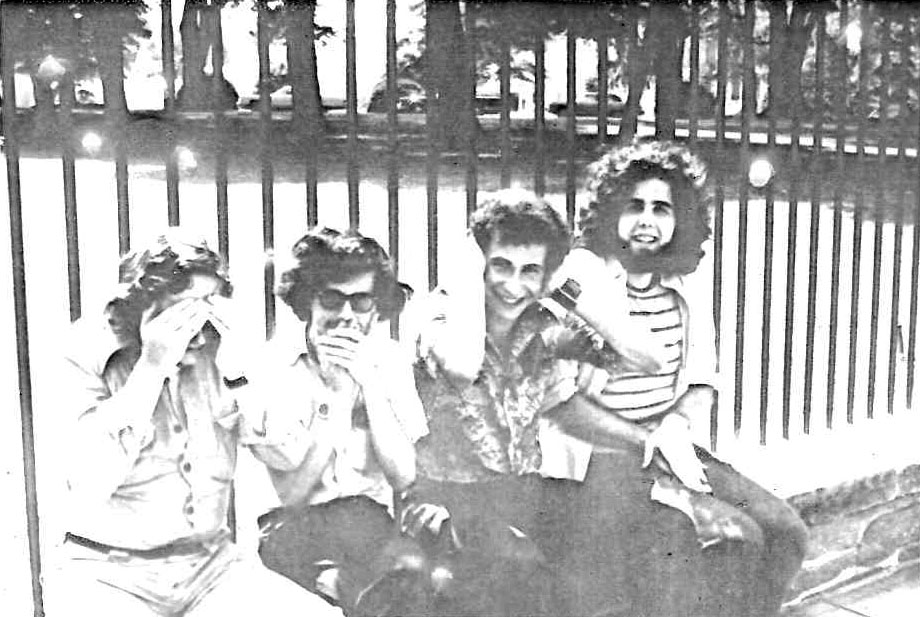
Like many of you, I’m currently making plans to attend Denvention 3, the 66th World Science Fiction Convention, to be held later this year in Denver. Looking ahead to yet another WorldCon brings back memories of my first WorldCon, Discon II, the 32nd World Science Fiction Convention, held in Washington, D.C. back in 1974.

DCWorldconPhotocopy

I was still living in Brooklyn with my parents at the time, and drove down in a van with a group of other fans. Here’s the only photographic evidence of that trip. The image is fairly faded by now, because I don’t have an original print, only a poor photocopy. (Click above to see a larger version of these four sorry mugs.) This photo was snapped on a day we stole away from the con for a few hours to play tourists. We’re sitting in front of the fence that surrounds the White House.

Who are these four stooges? See No Evil is comic-book colorist Carl Gafford. Speak No Evil is Paul Levitz, then just a green employee at DC Comics, the company for which he is now Publisher. Hear No Evil is Steve Gilary, a fellow comic-book fan. And as for me at the far right, well … by the placement of my hands, I guess my role is Do No Evil. So while my hair may have changed with the years, my habit of hamming it up for the camera has remained consistent.

It was a great first WorldCon, and if I ever find the clipping of the article I wrote about the experience for the Brooklyn College student newspaper, I’ll upload that as well.

It’s Itzkoff, alas

Posted by: Scott    Tags:  Bill Hader, David Itzkoff, R.A. Lafferty    Posted date:  February 3, 2008  |  No comment


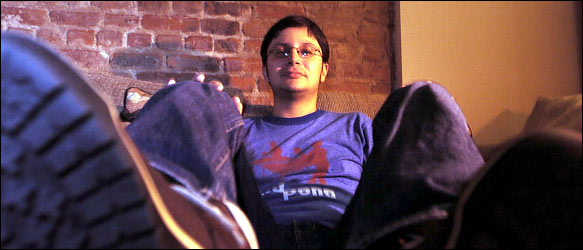
Dave Itzkoff is blathering again in the pages of the New York Times, once more demonstrating himself to be a critiquer of a field for which he feels only embarrassment. It’s as if the newspaper has, after a long search, managed to select the anti-Michael Dirda as its regular SF reviewer.

DavidItzkoff

There are times that I almost wish that the New York Times didn’t cover SF at all rather than have Itzkoff covering it, because I don’t like having to wince several times whenever I read each of his columns. Today, for example, while praising two YA novels, he actually begins by slamming the entire genre:

I sometimes wonder how any self-respecting author of speculative fiction can find fulfillment in writing novels for young readers. I suppose J. K. Rowling could give me 1.12 billion reasons in favor of it: get your formula just right and you can enjoy worldwide sales, film and television options, vibrating-toy-broom licensing fees, Chinese-language bootlegs of your work, a kind of limited immortality (L. Frank Baum who?) and—finally—genuine grown-up readers. But where’s the artistic satisfaction? Where’s the dignity?

Where’s the artistic satisfaction, Dave? Where’s the dignity? (more…)

A lack of Candorville at the Washington Post

Posted by: Scott    Tags:  censorship, comics    Posted date:  February 1, 2008  |  No comment


It was revealed in this week’s online chat with Washington Post columnist Gene Weingarten that the paper refused to publish the January 19 installment of the comic strip Candorville.

Here it is for those of you in the DC area who had to settle for a replacement that day. (Click to see the strip at a more readable size.) I have no idea whether any other newspapers took the same action.

Candorville

Participants in the chat took both sides, with a few mentioning that different versions of the joke had been made previously by comedians Dick Gregory and Dave Chapelle.

Touched by human hands

Posted by: Scott    Tags:  Robert Sheckley    Posted date:  January 31, 2008  |  No comment


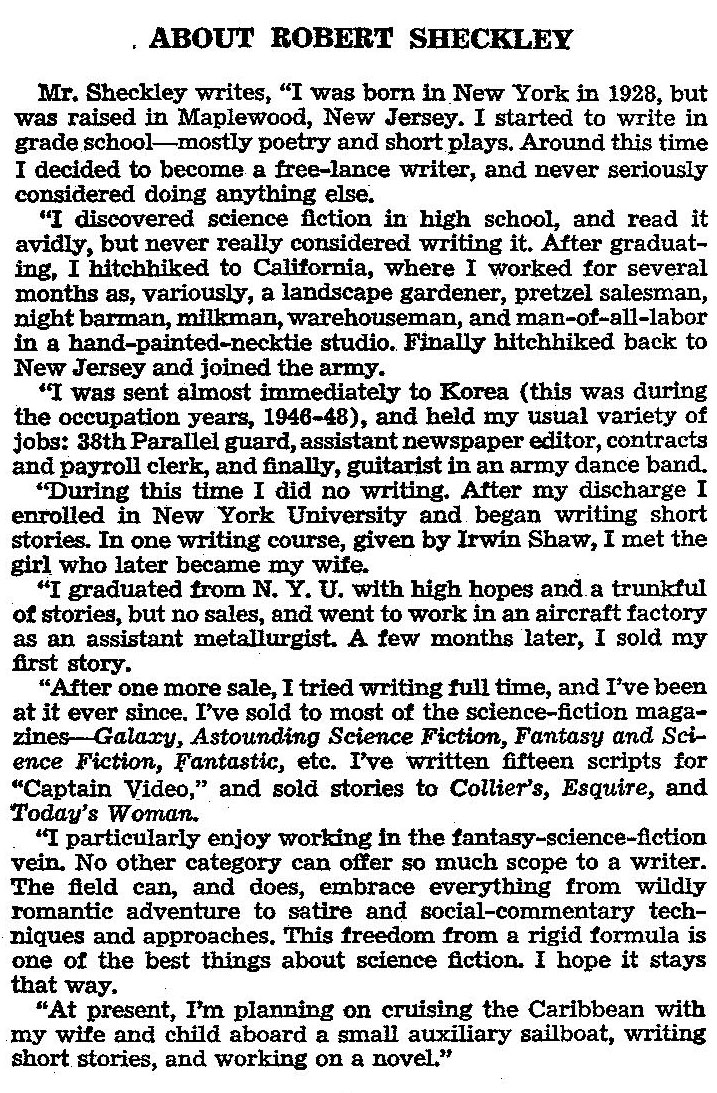
I’ve been looking back at Robert Sheckley’s first short-story collection, Untouched by Human Hands. It was published in 1954, when Sheckley would have been 26 (or maybe only 25, depending on what part of the year the book came out). It includes his classic story “The Monsters,” originally published in F&SF, which I like to reread every couple of years.

RobertSheckley

But what attracted my attention the most this time was his biographical blurb from the last page, which listed his previous jobs from his first quarter century as: (more…)

Magazine publishing circa 1893

Posted by: Scott    Tags:  old magazines, The Cosmopolitan    Posted date:  January 28, 2008  |  No comment


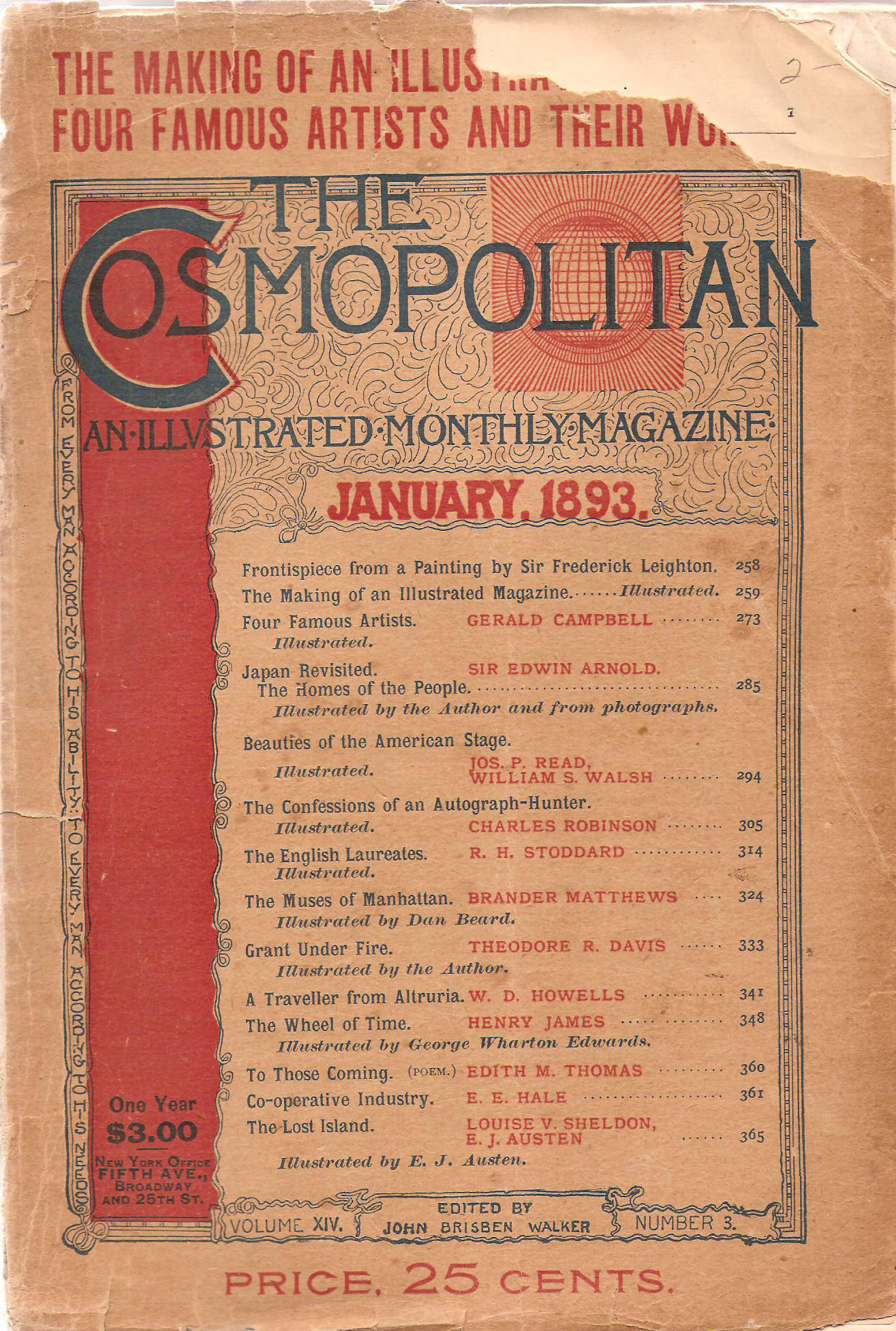
It’s said that the two things you should never see being made are sausages and the law, but to that list you should add magazines. It can be an ugly process. And yet the editors of The Cosmopolitan, one of the leading general-interest magazines in the country, decided to share their secrets with a lengthy article in the January issue.

Cosmopolitan1893

That’s the January 1893 issue, as you can see by my somewhat tattered copy.

In an article titled “The Making of an Illustrated Magazine,” readers are taken through the entire publishing process, from start-up costs, to the difficulties of obtaining advertising, to that stack of unsolicited manuscripts that has existed at every magazine since the first issue of the first magazine was carved into stone tablets.

Here are a few choice excerpts from that 14-page article, which show that perhaps time really hasn’t changed things that much after all. (more…)

‹ Newest 351 352 353 354 355 356 357 358 359 360 Oldest ›
  • Follow Scott


  • Recent Tweets

    • Waiting for Twitter... Once Twitter is ready they will display my Tweets again.
  • Latest Photos


  • Search

  • Tags

    anniversary Balticon birthdays Bryan Voltaggio Capclave comics Cons context-free comic book panel conventions DC Comics dreams Eating the Fantastic food garden horror Irene Vartanoff Len Wein Man v. Food Marie Severin Marvel Comics My Father my writing Nebula Awards Next restaurant obituaries old magazines Paris Review Readercon rejection slips San Diego Comic-Con Scarecrow science fiction Science Fiction Age Sharon Moody Stan Lee Stoker Awards StokerCon Superman ukulele Video Why Not Say What Happened Worldcon World Fantasy Convention World Horror Convention zombies