Scott Edelman
  • Home
  • Blog
  • About
  • Writing
    • Short Fiction
    • Books
    • Comic Books
    • Television
    • Miscellaneous
  • Editing
  • Podcast
  • Contact
  • Videos

©2026 Scott Edelman

My despair is more than just an ornament

Posted by: Scott    Tags:  Chris Foss, Glenn Brown    Posted date:  January 7, 2014  |  18 Comments


You already know how I feel about artists who ransack the imaginations of others for profit, whether it’s Roy Lichtenstein’s clumsy appropriations, Mel Ramos’ $600,000 Green Lantern painting, or Sharon Moody’s anonymization of Jack Kirby. (Remember, though, that I’ve also told you I see nothing wrong with mashups, smashups, allusions, tributes, or homages.)

So it should come as no surprise that I’m horrified by the £3,554,500 ($5,684,356) Glenn Brown’s painting “Ornamental Despair (Painting for Ian Curtis)” sold for at auction.

GlennBrownOrnamentalDespair

Why? Well, doesn’t it seem a bit … familiar?

It should.

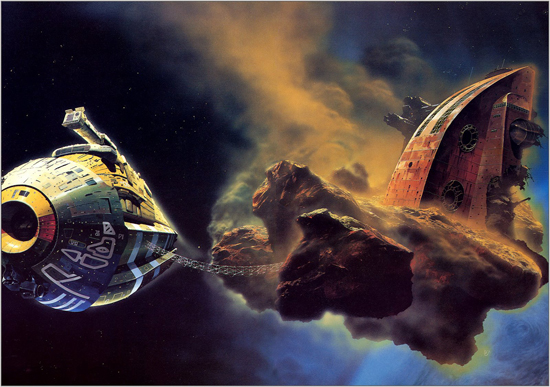
Because, save for a few minor tweaks, it’s nearly identical to the cover Chris Foss painted for a 1984 edition of Isaac Asimov’s The Stars Like Dust.

ChrisFossTheStarsLikeDust

I’m not accusing Brown of failing to provide attribution, because when interviewed, he does credit the true source of his paintings. However, he at the same time makes the claim that his works are oh-so-different from the originals:

Lynn MacRitchie: And to use the word you used earlier, “appropriation,” I think that in your early days you kind of appropriated that theatricality, that operatic quality, from people like Chris Foss, or John Martin—surely the master of operatic painting. But now that desire to create a sort of spectacle, a sort of grandeur, seems to me to be coming from inside the paintings instead of being copied from outside, if that makes sense.

Glenn Brown: I think that does some of the early paintings a slight injustice, in that the Foss paintings never look like my versions of them. Mine are always played around with. The colors are altered, the cities were redrawn and I was always inventing things to increase their intensity right from the start. Even 16 years ago I was playing with the images to increase that sense of the Gothic. It was partially there in Chris Foss’s work, but not in quite the same way. All the while I was sort of learning what you can do, learning different techniques from other people. But I never want to lose that notion of appropriation—people say to me, sooner or later you’ll stop copying other artists and you’ll make work of your own, but it’s never been my point to try to do that, because I never thought you ever could. The work is always going to be based on something, and I wanted to make the relationship with art history as obvious as possible. Again, I think it increases the intensity of the way that people look at things.

Which to me translates as—since we can never be truly free from our influences when we create, why even try? Brown’s attitude seems to be a fatal shrug of surrender that allows him to abandon any effort at tapping his own imagination so he can instead embrace the far easier path of pilfering others, all the while claiming to have created something new and more important than the work which has been copied.

To repeat, I have nothing against artists of all kinds referencing other works when that work ends up being transformative.

But Glenn Brown’s work is not transformative.

What causes me to fulminate about this now when the auction that put money belonging to Foss into Brown’s pocket occurred several months ago is a video Bob Eggleton shared yesterday over on Facebook. In it, James Sevier of Sotheby’s attempts to explain Brown’s motivations.

I find his exegesis laughable, because as you can see by comparing the two images above, Brown is almost entirely absent.

Says Sevier: “This painting challenges the viewer to imagine a space which is totally foreign … unknown.”

Actually … no. What it challenges the viewer to imagine is … how much chutzpah is it possible for one artist to possess?

Sevier concludes with: “Brown, in this work, asks multiple questions. There’s so many different narratives unfolding before our eyes, but none of them are conclusively answered.”

Oh, yes, there are multiple questions not conclusively answered. But I’m afraid they aren’t the ones Sevier would have us think. They are:

Does Sevier believe any of this, or is it simply the sort of hyperbolic thing one must say when hoping to excite bidders at auction?

Regardless of what Sevier believes, can Brown truly believe it?

If so—how?

Has it ever occurred to Brown to send any of that £3,554,500 to Foss, il miglior fabbro, since it’s Foss who did most of the heavy lifting here?

If not, why not?

I’d ask these and other questions of Brown and Sevier myself, but as you’ll discover if you click through to watch the video directly on YouTube, “Comments are disabled for this video.”

To which I say—if you don’t want to hear what the Internet thinks of the artistic crimes you’ve committed, how about, instead of silencing critics, you just stop committing them?


18 Comments for My despair is more than just an ornament


karen wester newton

“This painting challenges the viewer to imagine a space which is totally foreign … unknown.”

It does, but the painter who asked the question is NOT the one getting the money for asking it!

Why are people who steal others’ words chastised and people who steal others’ images getting multi-million dollar checks?

If this guy wants to rip off other artists, he should start with the long-dead. I am sure DaVinici and Vermeer won’t mind.

Paul Riddell

I’m to the point of encouraging artists to do with their work what Kurt Vonnegut did with his fiction: namely, refusing to allow it to be categorized as “sci-fi” or “comic book”. The real reason why the plagiarists are able to get away with this is because of fans of the style who don’t want to have to associate with science fiction fans (or be associated with them) to get to it. Of course, this means that the Cat Piss Men will scream bloody murder about the artists “selling out”, but it’s not like they were buying any of this work anyway.

Michael Ward

I don’t understand who would buy this artwork, and I don’t understand why they would buy it. According to the auction report you linked to, it went to a telephone bidder, presumably unidentified, at a hundred times what it went for in 2002. Do they expect to sell it next decade to some bigger fool?

There has to be some other story hidden away here: who is Glenn Brown? Who is pushing his art to the auction houses? Is the boyfriend of some major art critic? Does he have blackmail photos of the head of an auction house?

Since this is in the UK, don’t the creator’s Moral Rights apply? Perhaps Foss can be benefit from this in some fashion. I note that the full title, given in the auction house article, includes the credit that it was “copied from Chris Foss.”

Mike

Kim

If I wrote an academic paper with the same degree of fidelity to the original author as is shown between Foss’ and Brown’s compositions I’d be charged with plagiarism. This is one intellectually and creatively lazy person.

iofur

hum.. plagiarism is not a crime un the UK ? I think Chriss Foss could initiate legal actions in defense of his authors rights.

Paul Chadwick

That’s pretty breathtaking appropriation. He could have at least added Ben Day dots.

Kim’s point about the different treatment of written plagiarism is striking. If a reporter or columnist cuts and pastes even a few fragments of another’s work, he’s hounded from the profession. Johann Hari and Jayson Blair, for example.

K. Coleman

This sickening, postmodern, artspeak justification for what is basically stealing makes me sick. Get your own ideas brown. Copy someone who’s dead. I hope they sue him into paste.

Maere

Seriously. This cannot possibly be legal. Why hasn’t he been sued already?

Robnonstop

How do you feel about the fake Morgan Freeman iPad painter…

http://HowToLearnDrawing.com/fake-morgan-freeman-ipad-finger-painting-hoax-debunked

…who swiped Ryan Hitch’s Hulk Art and put “Comic Artwork by Kyle Lambert” on it?

http://www.bleedingcool.com/2013/12/21/kyle-lambert-vs-bryan-hitch-finger-painting-or-finger-tracing-or-something-else/

    Scott

    I’m not down with it at all. I don’t see the new work as transformative, nor is it commentary on the original. As far as I’m concerned, it’s equivalent to identity theft.

Sean Walker

Though I completely agree with your argument, that copying a pre-existing artwork and doing something minor like making it bigger than the original and calling it original art is a lie and a scam, an artist never makes money on the re-sale of a work at auction. Once the painting in question is sold, the artist has sold the rights to that physical piece, and the only thing he gets when a piece is resold for a much larger sum at auction is it can boost the value of any other work the artist has or will make in the future. So Mr. Brown didn’t make out like a bandit when the painting was resold for 5.7 million.

    Scott

    You are entirely correct that the artist would not profit directly off a resale. I do have a vague memory of reading that some in the high-end art world were trying to institute a system in which new purchasers would obligate themselves during the initial sale to pay a percentage of any subsequent profit to the original artist, but I don’t believe that ever got any traction, and online searching isn’t yielding me any info.

    On the other hand, there exists a potential for indirect profit, in that the next time Brown sells one of these plagiarisms, the fact that this one did so well would increase the asking price of those future works of “art.” So he’s still riding on the backs of others.

    But you’re right that this money did not go directly into Brown’s pocket. And I’m glad. Because his would have been the wrong pocket.

      Bill B

      Living artists (and perhaps recently dead ones now) are entitled to payments under the Artist’s Resale Rights laws in Britain.
      http://www.dacs.org.uk/for-art-market-professionals/frequently-asked-questions#FAQ158

      Here’s a calculator:
      http://www.dacs.org.uk/for-art-market-professionals/arr-royalty-calculator.aspx

      However, the payment on a £3 million sale is only about £10,000, so the orignal purchaser who resold the painting gets the bulk of the revenue.

        Scott

        Thank you so much for contributing that detail! My Google-fu had failed me, and that’s an important piece of information.

    Paul Riddell

    And that’s the good side, because this exposure just guarantees that nobody will take this guy seriously again. I’m saddened by the fact that these know-nothing gallery owners will never once consider an exhibition of the original works, but I get one bit of glee out of knowing that Brown will now have to stand on his own ideas, meaning that he’s going to have a really mashed-up face. (In a way, I’m reminded of the poster darling Frank Kozik from twenty years ago, who made his name from similar blatant copying of cartoon characters for his band posters. Amazingly, when Disney and Hanna-Barbera started slapping him with cease-and-desist letters, and he had to fall back upon his own ideas, he kinda disappeared. I wonder why that was?)

Alex

Actually Kozik is still a very much a relevant and active artist, just maybe not in the high art bullshit circle. Maybe do a quick google search before you go running your mouth.

BrianB

This would be like paying an editor x number of times what an author gets from royalty with the editor’s name more prominently displayed on the book.

Pure, marketing bullshit. An injustice both for the original author and the buyer. If Brown’s work will amount to anything in the future, it will be as an example of human stupidity.

Georgia Gold

You may have a valid point here, but the fact that you acknowledge the validity of transformitive work, and in the opening sentence fail to realize the transformitive nature of Lichtenstein pretty much hangs a big neon sign over your head as not understanding anything about real art that is not work for hire for a comic company or book publisher.

Your inability to grasp what these artists do makes very clear that outsiders are not in a position to make those ‘rules’ you want to see, just like religious literalists trying to make rules about teaching science.


  • Follow Scott


  • Recent Tweets

    • Waiting for Twitter... Once Twitter is ready they will display my Tweets again.
  • Latest Photos


  • Search

  • Tags

    anniversary Balticon birthdays Bryan Voltaggio Capclave comics Cons context-free comic book panel conventions DC Comics dreams Eating the Fantastic food garden horror Irene Vartanoff Len Wein Man v. Food Marie Severin Marvel Comics My Father my writing Nebula Awards Next restaurant obituaries old magazines Paris Review Readercon rejection slips San Diego Comic-Con Scarecrow science fiction Science Fiction Age Sharon Moody Stan Lee Stoker Awards StokerCon Superman ukulele Video Why Not Say What Happened Worldcon World Fantasy Convention World Horror Convention zombies