
Scott Edelman
  • Home
  • Blog
  • About
  • Writing
    • Short Fiction
    • Books
    • Comic Books
    • Television
    • Miscellaneous
  • Editing
  • Podcast
  • Contact
  • Videos

©2026 Scott Edelman

Eavesdrop on Oghenechovwe Donald Ekpeki in Episode 185 of Eating the Fantastic

Posted by: Scott    Tags:  Eating the Fantastic, Oghenechovwe Donald Ekpeki    Posted date:  November 17, 2022  |  No comment


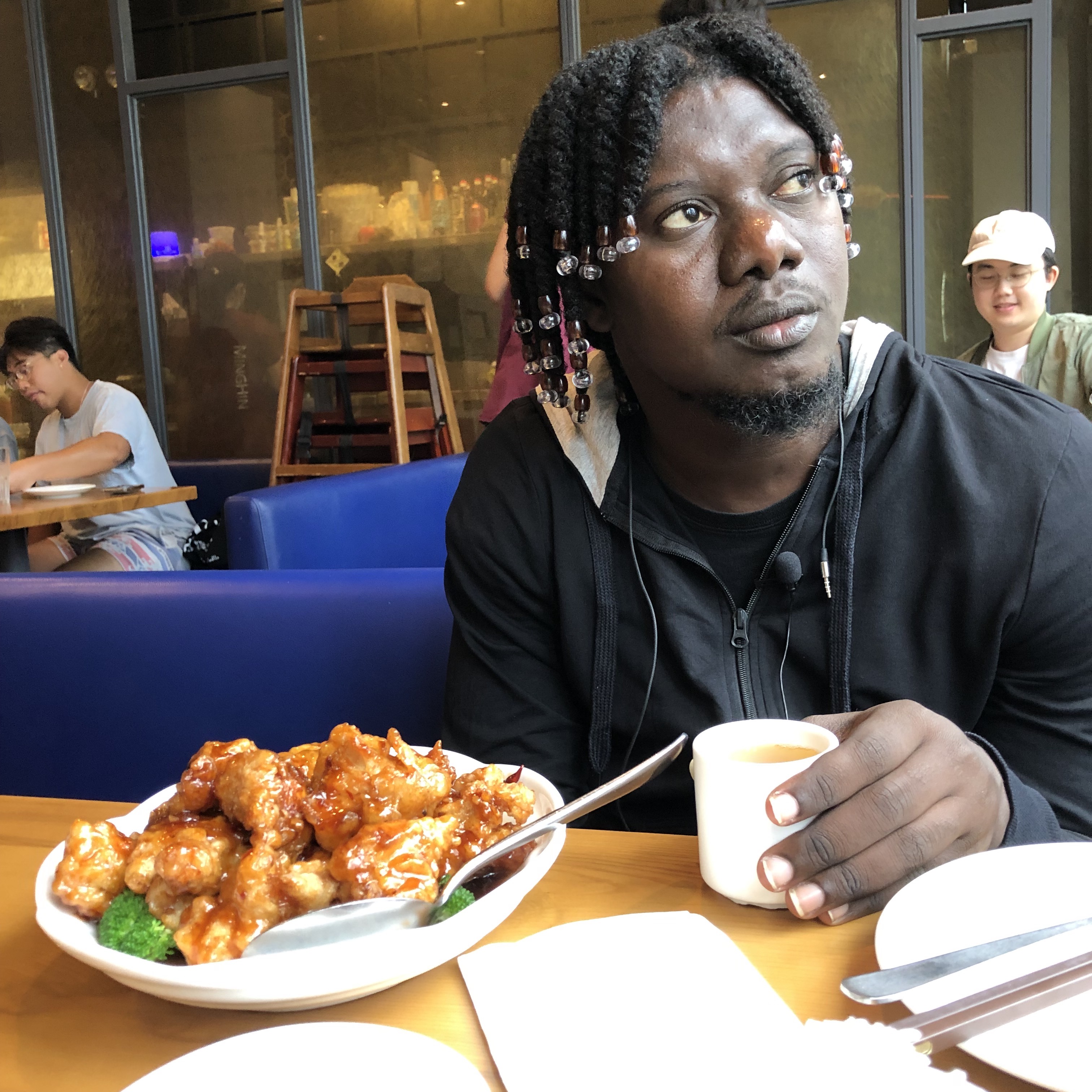
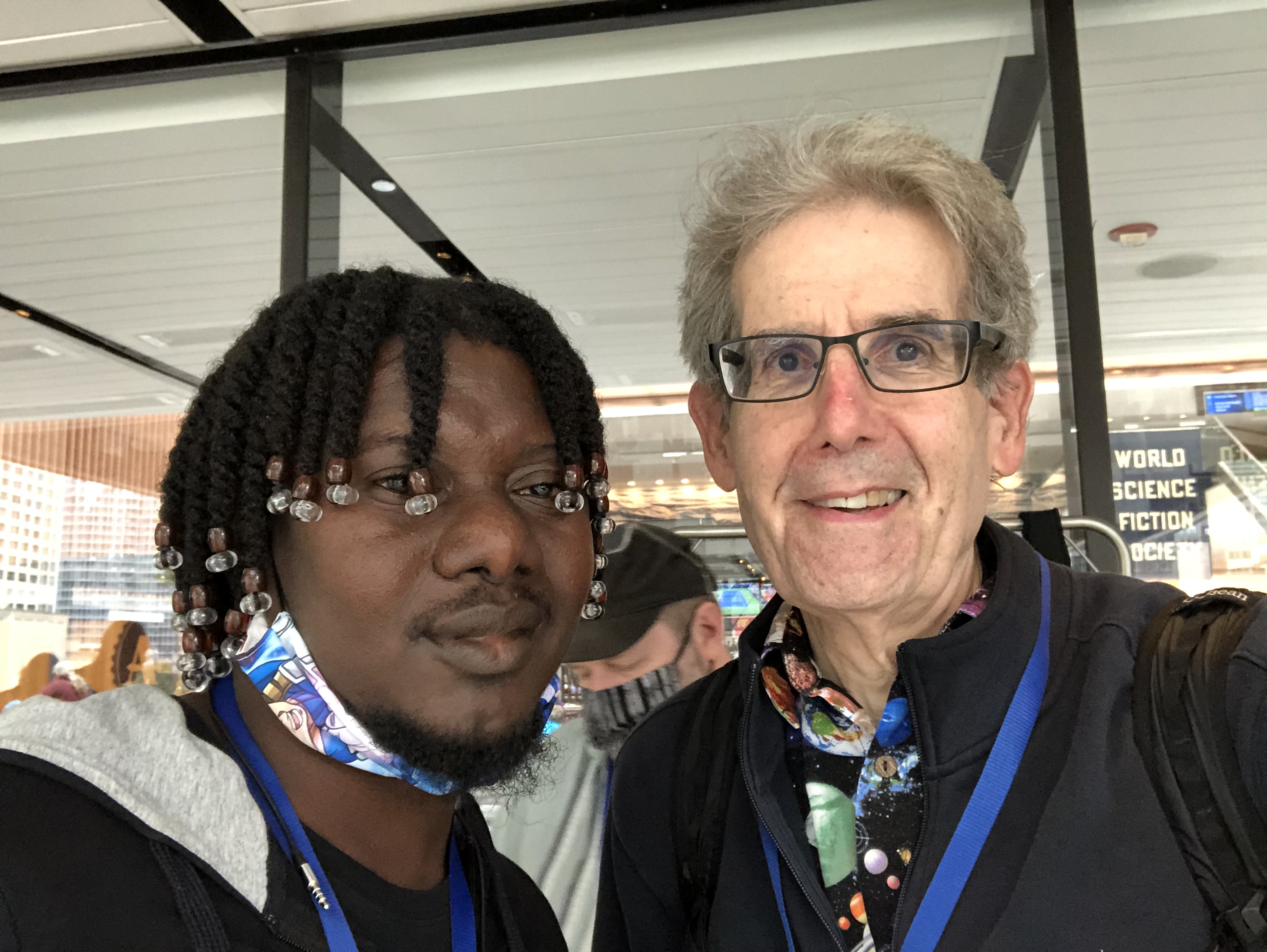
It’s time to take your seat at the table for the penultimate culinary conversation I’ll share from the 80th World Science Fiction Convention, following my chats there with Wesley Chu, Carol Tilley, Eileen Gunn, and Michael Swanwick. Now I invite you to join me at the table with the multi-award winning writer and editor Oghenechovwe Donald Ekpeki.

Ekpeki — who won the Best Novelette Nebula Award earlier this year for “O2 Arena” — was up for two Hugo Awards that weekend. Not only as a writer for “O2 Arena” again — but also in the category of Best Editor, Short Form. Plus earlier this month, he won a World Fantasy Award in the category of Best Anthology for The Year’s Best African Speculative Fiction. He has also won the Otherwise, Nommo and British Fantasy Awards, plus has been a finalist for the Locus, British Science Fiction Association, Theodore Sturgeon Memorial, and This Is Horror awards.

His fiction and nonfiction have appeared in or are forthcoming in Tordotcom, Apex Magazine, Strange Horizons, Asimov’s, Galaxy’s Edge, Cosmic Roots and Eldritch Shores, and more. In addition to editing that first ever — and now award-winning — Year’s Best African Speculative Fiction anthology, he also co-edited the award-winning Dominion: An Anthology of Speculative Fiction From Africa and the African Diaspora, as well as — most recently — the Africa Risen anthology from Tordotcom, co-edited with Sheree Renée Thomas and Zelda Knight.

We discussed the reason “shocked” seemed an inadequate word to describe his feelings about winning a Nebula Award earlier this year, what he considered the true prize he won over his Worldcon weekend, how growing up next to a library changed his life, how writing fan fiction helped him get where he is today, the way reading the struggles of a certain character in a Patrick Rothfuss novel helped him deal with his own struggles, what caused him to say “the law cannot help you change the law,” when he decided his novella “Ife-Iyoku, Tale of Imadeyunuagbon” deserved to be a trilogy, the way he does his best work when backed into a corner, how it’s possible for three editors to edit an anthology, and much more.

Here’s how you can join us — (more…)

Robert Graves explains why I left comics behind

Posted by: Scott    Tags:  Clarion, comics, poetry, Robert Graves    Posted date:  November 15, 2022  |  No comment


Getting hired to work on staff at mid-’70s Marvel Comics was a dream come true. And having the chance to write comics both for them, and after I went freelance, for DC Comics as well, and being able to play with such characters as Captain Marvel, Supergirl, Spider-Man, The Vision, and others was a joy.

So why, when I applied to the Clarion Science Fiction Writing Workshop in 1979, did I beg them to let me in so I could turn my back on comics?

Over the years, I’ve offered up two reasons —

The first is that during my years in the field, my fiction output dwindled severely. Before turning from comics fan to comics pro, I was writing short stories endlessly. Sometimes one a week. Sometimes even more frequently than that, because in an essay for one of the Clarion anthologies, Harlan Ellison explained (or perhaps someone else told of his week teaching there) how he asked students to write a story a day during his stint. I can’t remember the purpose of such an exercise, but whatever its reason, I lasted three days.

But those stories continued to pour out of me … until I went to work in comics. It’s a difficult thing to bring yourself to work on a story which might take years to sell, when every word I could write in comics and hand in one week — from letter columns to splash pages for the British reprint books to ad copy — would earn me a check the following week. Sometimes that payment only took days. Which is why when I encountered the following George Bernard Shaw quote, it resonated mightily: “If you want to be a writer, you must have money, otherwise people will throw money at your head to buy your talent to use it and distort it for their own frivolous purpose.” I knew that if I didn’t wean myself from the comics income, I might never return to working on my fiction in earnest.

More importantly, though, I found my time in comics was damaging my actual ability to write the fiction I wanted. My time at Marvel was spent aping Stan Lee. So facile was I at that task I even wrote the Bullpen Bulletins copy for a while. (Don’t worry — Stan always wrote those Soapboxes himself.) But what I found was that because I was young and immature — I started on staff at Marvel at only 19 — I was unable to maintain a wall between the style of writing I did for myself and the one I used for comics. My short stories were beginning to sound like Stan, filled with bombast and alliteration. I realized that if I didn’t leave comics, I might never find my own voice.

So I broke away, working a series of non-creative jobs which protected that part of myself. It wasn’t until the early ’90s that I’d matured enough to allow myself a creative staff job — creating and editing Science Fiction Age magazine — knowing I no longer had to fear the loss of my voice.

My journey into and then out of the comics industry is much more complicated than that, with many twists and turns, and when asked how I could walk away from such a magical field, I’ve often expounded on all of the above in greater detail. But just the other day, I stumbled across a poem by Robert Graves titled “Epitaph on an Unfortunate Artist” which explains my quandary far more succinctly than I ever could —

He found a formula for drawing comic rabbits:
The formula for drawing comic rabbits paid.
So in the end he could not change the tragic habits
This formula for drawing comic rabbits made.

I consider myself lucky to have gotten away in time, before those tragic habits became unchangeable.

Your context-free comic book panel of the day

Posted by: Scott    Tags:  context-free comic book panel    Posted date:  November 8, 2022  |  No comment


Your context-free comic book panel of the day

Posted by: Scott    Tags:  context-free comic book panel    Posted date:  November 4, 2022  |  No comment


Munch Carnitas Benedict with the award-winning Michael Swanwick in Episode 184 of Eating the Fantastic

Posted by: Scott    Tags:  Eating the Fantastic, Michael Swanwick    Posted date:  November 4, 2022  |  No comment


Out in the flesh and blood world, the 80th World Science Fiction Convention is long over, but here at Eating the Fantastic — where I’ve already invited you to eavesdrop on my meals there with Wesley Chu, Carol Tilley, and Eileen Gunn — it lives on. This time around, for the fourth of six culinary conversations I managed to find time for during a busy Worldcon, I invite you to join me for brunch with Michael Swanwick

Michael has won five Hugo Awards and three Locus Awards, as well as a Nebula, World Fantasy, and Theodore Sturgeon Memorial Award — plus has been nominated for and lost more of these major awards than any other writer. His novels include Vacuum Flowers, Stations of the Tide, and Bones of the Earth, plus his most recent, City Under the Stars, a novel co-authored with the late Gardner Dozois. He’s also published a baker’s dozen of short story collections over the past three decades, starting with Gravity’s Angels in 1991 and most recently Not So Much Said the Cat in 2016, as well as the 118 short stories included in The Periodic Table of Science Fiction, one per each element. His recent novel The Iron Dragon’s Mother completed a trilogy begun with The Iron Dragon’s Daughter in 1993, which was named a New York Times Notable Book. Two of his short stories — “Ice Age” and “The Very Pulse of the Machine” — were adapted for the Netflix series Love, Death + Robots.

We discussed his response to learning a reader of his was recently surprised to find out he was still alive, how J. R. R. Tolkien turned him into a writer, why it took him 15 years of trying to finally finish his first story, how Gardner Dozois and Jack Dann taught him how to write by taking apart one of his tales and putting it back together again, why it was good luck he lost his first two Nebula Awards the same year, the good advice William Gibson gave him which meant he never had to be anxious about awards again, which friend’s story was so good he wanted to throw his own typewriter out the window in a rage, the novel he abandoned writing because he found the protagonists morally repugnant, why he didn’t want to talk about Playboy magazine, the truth behind a famous John W. Campbell, Jr./Robert Heinlein anecdote, and much more.

Here’s how you can join us — (more…)

Your context-free comic book panel of the day

Posted by: Scott    Tags:  context-free comic book panel    Posted date:  October 25, 2022  |  No comment


“Recollections of a Comic Book Writer of (almost) 50 Years” by Paul S. Newman

Posted by: Scott    Tags:  comics, Ellen Vartanoff, Paul S. Newman, Stan Lee    Posted date:  October 24, 2022  |  No comment


I found another treasure in the papers of my late sister-in-law Ellen Vartanoff — the text of a speech given in 1977 by comic book writer Paul S. Newman. Newman was listed in The Guinness Book of World Records as the most prolific comic book writer of all time, and since in 1977 he lived in the D.C./.Maryland area, she invited him to speak at one of the cartooning shows she curated back then.

Since I can’t find the text of this presentation anywhere else on line, I share it here with you. He called it —

“Recollections of a Comic Book Writer of (almost) 50 Years”


In the summer of 1948, after my fifth rewrite, I finally had my first comic book story accepted by National Comics (now DC).

It was for their Date with Judy teen-age humor book. My second story required only two rewrites. That assured the editor and me that I could write comic book scripts, but neither of us ever guessed I’d eventually write some 4,121 stories and still be writing them.

However, the truly amazing thing is not that I succeeded in selling so many stories, but to get the 4,121 approved, I had to submit an additional 5,000 plot ideas, which were rejected, and that despite all those rejections, I didn’t commit suicide.

Naturally, writing comics for fifty years leaves one with many memories. Here are some very random recollections:

I started writing for Stan Lee about 1950, probably with a story for Patsy Walker, and quickly went on to write for his science-fiction, “horror,” and other books. Stan was a smiling, encouraging editor to work with. I would bring in a plot outline, and Stan would immediately say “yes … no … ” or suggest a way to save it. Once, Stan seemed even more helpful, advising me that he would “give” me a plot, stating, “A man checks into a hotel …” I wrote that down rapidly. Stan continued, “They assign him a room on the 13th floor …” I noted that and there was a pause. I looked up from my pad. “And then, Stan?”

“Make it five pages, Paul.”

A year or so later, romance comics were hot (the sales, not the stories) and Stan said he wanted me to try writing some. I advised Stan that romance wasn’t my style. He shoved half a dozen romance books into my arms and said, “Try.”

The next day, I sent down a six pager, which began with a splash panel showing a girl dancing with one man and looking over his shoulder at another man in the background. “I was dancing with Ted. He pressed me close, but I knew it was the stranger in back, whom I really loved …” I was too much of a coward to subway down to Stan and watch his reaction, as he scanned it. I sent the story down by messenger.

A few hours later the phone rang. Sure it was Stan, I didn’t answer it until my wife forced the receiver into my hand. “It’s great, Paul. Give me three more.” And suddenly in half a dozen Marvel romance titles, I was pouring out my heart.

Although, writing for over six publishers in the early 1950s, I kept wanting to write for the biggest of them all, Western Publishing. The editor liked my published samples, but had no book available. I went back the following month, still nothing available. I went back the following month, and for ten more months, and then there was an opening: I began to write The Lone Ranger for the next 24 years. That was not my longest running comic. Turok, Son of Stone (not the stoned dinosaur hunter one) was. I kept Turok and Andar from escaping from Lost Valley for over 26 years, getting Turok out once, however, in an alien flying suácer in issue #58, July 1967.

Incidentally, except for 3 issues of Beware in the early 1950s, my name did not appear in print on any of the thousands (yes, thousands) of other stories I have written. Even among the five comic strips I wrote, only one, The Lone Ranger, carried my name.

Besides Stan Lee, one other editor was extremely important to me, Matthew H. Murphy, the brilliant editor at Western. While Western specialized in doing books based on licensed characters, and many of which I wrote: I Love Lucy, Gunsmoke, Lassie, Star Trek, and on and on, today, the properties that are still going on are two originals that Matt developed and which I wrote, with some creative input as well: Turok, Son of Stone and Dr. Solar.

In the course of writing so many licensed TV and film properties, I frequently met the “live” heroes of my books. Clayton Moore (The Lone Ranger) turned out to be a charming man, whose eyes (even when seen through the Ranger’s mask’s openings) suggested authentic sincerity, and whose deep, authoritative voice convinced me that was how the old Testament’s prophets must have sounded. There was Clint Walker (Cheyenne) looming over me, a friendly giant, in whose huge extended hand I lost mine. But the most unusual “live” hero I ever met wasn’t even human; he was Smokey the Bear.

The Forest Service flew Morris Gollub, the talented artist of the series and the comic strip, and me to Washington for a publicity photo with Smokey. Unfortunately, when we reached his caged-in area, Smokey had retreated into the shadowy depths of his “cave”. The keeper called. Smokey did not come out. The keeper tossed some ursine delicacies in front of the cave. Smokey did not come out. The keeper entered the cave and pushed. Smokey did not come out. The photographer stood waiting with the frustration we all shared, when I offered, “I know Smokey’s psychology better than any of you. I write his dialog. I know what will get him out.” By that time Smokey was popular enough to have a whole line of souvenirs and memorabilia for sale. So I tossed a quarter in front of his cage. CLINK! A moment later, the market-oriented bear emerged, and we got our photo.

As far as artists were concerned, I knew only two of them fairly well: TOM GILL (The Lone Ranger) and Albert Giolitti (Turok). I actually avoided meeting fellow writers and artists, as all I wanted to do was get to my publisher, discuss plots with the editor, go home and write stories.

I wrote comic books to pay the mortgage, the food bill, and for my kids’ new shoes. I certainly enjoyed it and was lucky in that I could write some 2,000 pages a year during several years. I never even complained about my name not being on a comic book page — as long as it was spelled correctly on the check, for I “knew” what would bring me fame and fortune. It wasn’t comics. It was writing plays for Broadway, and screenplays for Hollywood. And while I have had five plays optioned for Broadway, and have sold five screenplays to movie producers, I have never had any of those scripts produced. Thanks to good genes and even better physicians, I am still writing at 73, both for the comics, as well as having two screenplays currently surfing around the West Coast, and just delivered a new novel to a top agent. Maybe next year, one of them will hit. Meanwhile, as we said in the old days — “see you in the funny pages!”

And I hoped you enjoyed some stories I wrote on my way to becoming, King of the Comic Book Writers.

Your context-free comic book panel of the day

Posted by: Scott    Tags:  context-free comic book panel    Posted date:  October 24, 2022  |  No comment


Your context-free comic book panel of the day

Posted by: Scott    Tags:  context-free comic book panel    Posted date:  October 23, 2022  |  No comment


Your context-free comic book panel of the day

Posted by: Scott    Tags:  context-free comic book panel    Posted date:  October 22, 2022  |  No comment


‹ Newest 53 54 55 56 57 58 59 60 61 62 Oldest ›
  • Follow Scott


  • Recent Tweets

    • Waiting for Twitter... Once Twitter is ready they will display my Tweets again.
  • Latest Photos


  • Search

  • Tags

    anniversary Balticon birthdays Bryan Voltaggio Capclave comics Cons context-free comic book panel conventions DC Comics dreams Eating the Fantastic food garden horror Irene Vartanoff Len Wein Man v. Food Marie Severin Marvel Comics My Father my writing Nebula Awards Next restaurant obituaries old magazines Paris Review Readercon rejection slips San Diego Comic-Con Scarecrow science fiction Science Fiction Age Sharon Moody Stan Lee Stoker Awards StokerCon Superman ukulele Video Why Not Say What Happened Worldcon World Fantasy Convention World Horror Convention zombies