
Scott Edelman
  • Home
  • Blog
  • About
  • Writing
    • Short Fiction
    • Books
    • Comic Books
    • Television
    • Miscellaneous
  • Editing
  • Contact
  • Videos

©2012 Scott Edelman

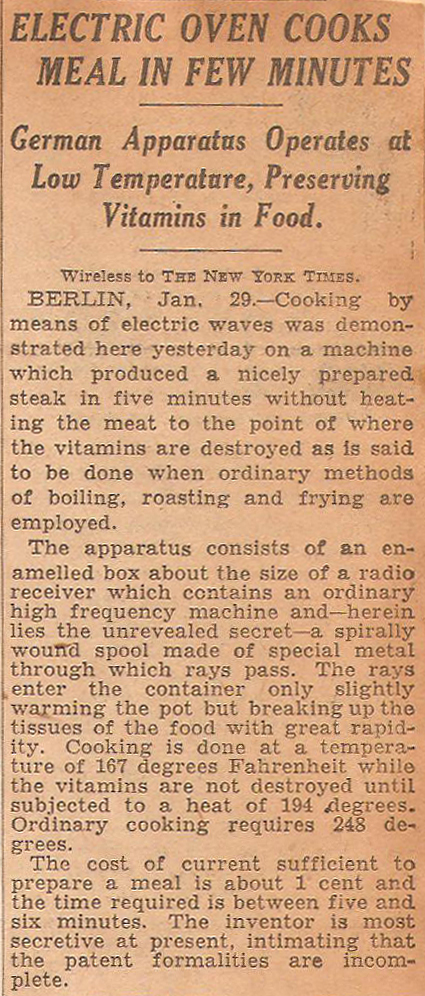
The first microwave was unveiled in … 1931?

Posted by: Scott    Tags:  old newspapers    Posted date:  December 18, 2011  |  1 Comment


Everything I know about the timeline of the microwave—which isn’t much—I learned from Wikipedia.

Date #1 to keep in mind: “The specific heating effect of a beam of high-power microwaves was discovered accidentally in 1945 … ” (I did know it was an accidental discovery, though not the year.)

Date #2 to note: “The use of high-frequency electric fields for heating dielectric materials had been proposed in 1934 … ”

If that’s the case, then how is it that the following article appeared in the February 1, 1931 issue of the New York Times, reporting that “cooking by means of electric waves was demonstrated here yesterday on a machine which produced a nicely prepared steak in five minutes” and that “the apparatus consists of an enamelled [sic] box about the size of a radio receiver which contains an ordinary high frequency machine”?

Is there something I’m not getting here because I’m scientifically illiterate? Wasn’t what happened in 1931—”cooking by means of electric waves” in “an enamelled box”—a microwave oven?

Educate me, all you big brains out there!

Would you eat duck if it was treated like veal?

Posted by: Scott    Tags:  food, old newspapers    Posted date:  October 8, 2011  |  No comment


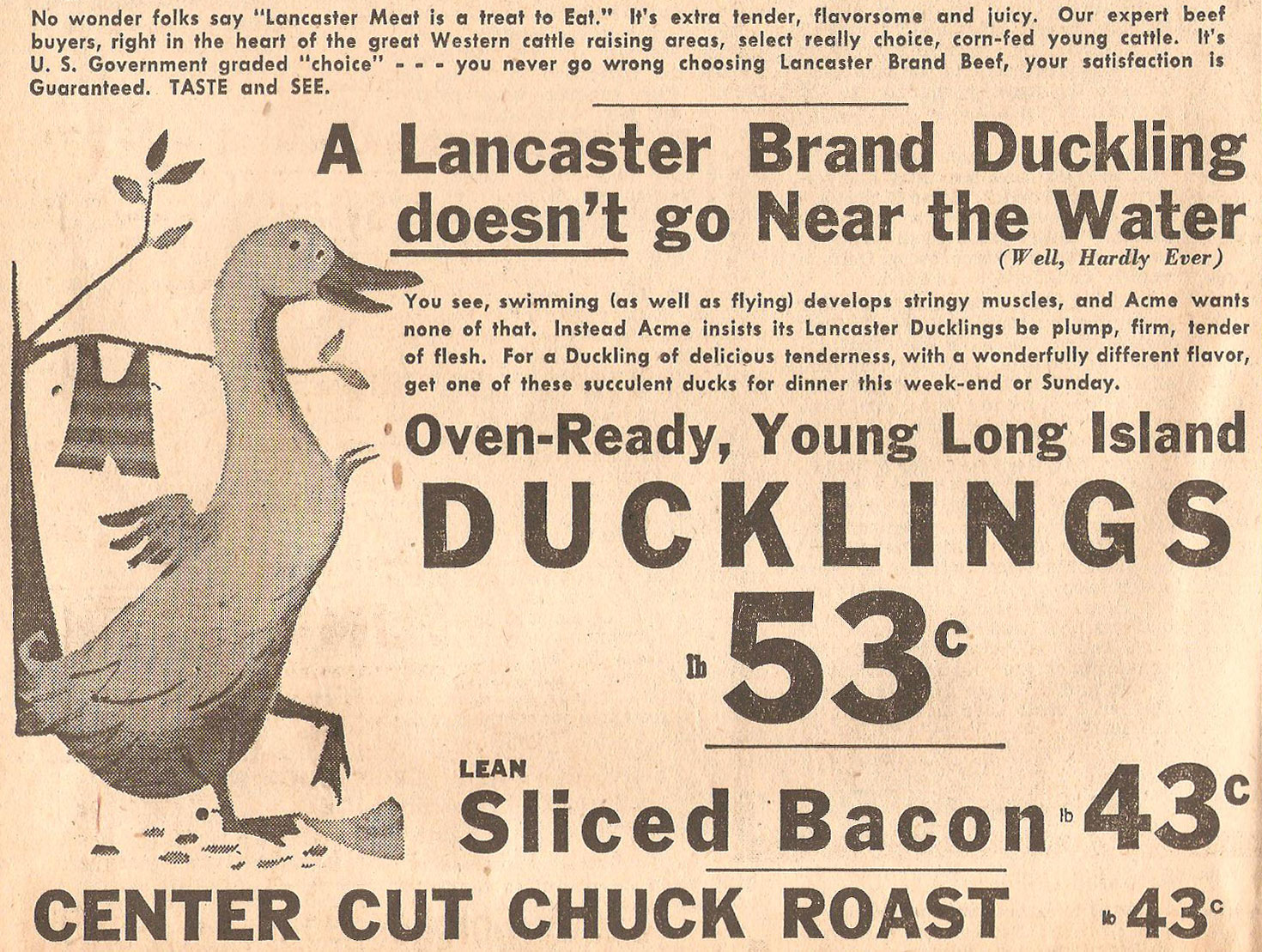
An ad for Acme Supermarkets (where I guess Wile E. Coyote used to buy all his hunting gear) in the February 10, 1955 issue of the Washington, D.C. Evening Star hints that the ducks the company sells are treated like veal.

According to the ad, “swimming (as well as flying) develops stringy muscles, and Acme wants none of that.”

No wonder that bathing suit is hanging on a tree branch. The duck isn’t allowed to wear it.

I suddenly feel very sad for that duck.

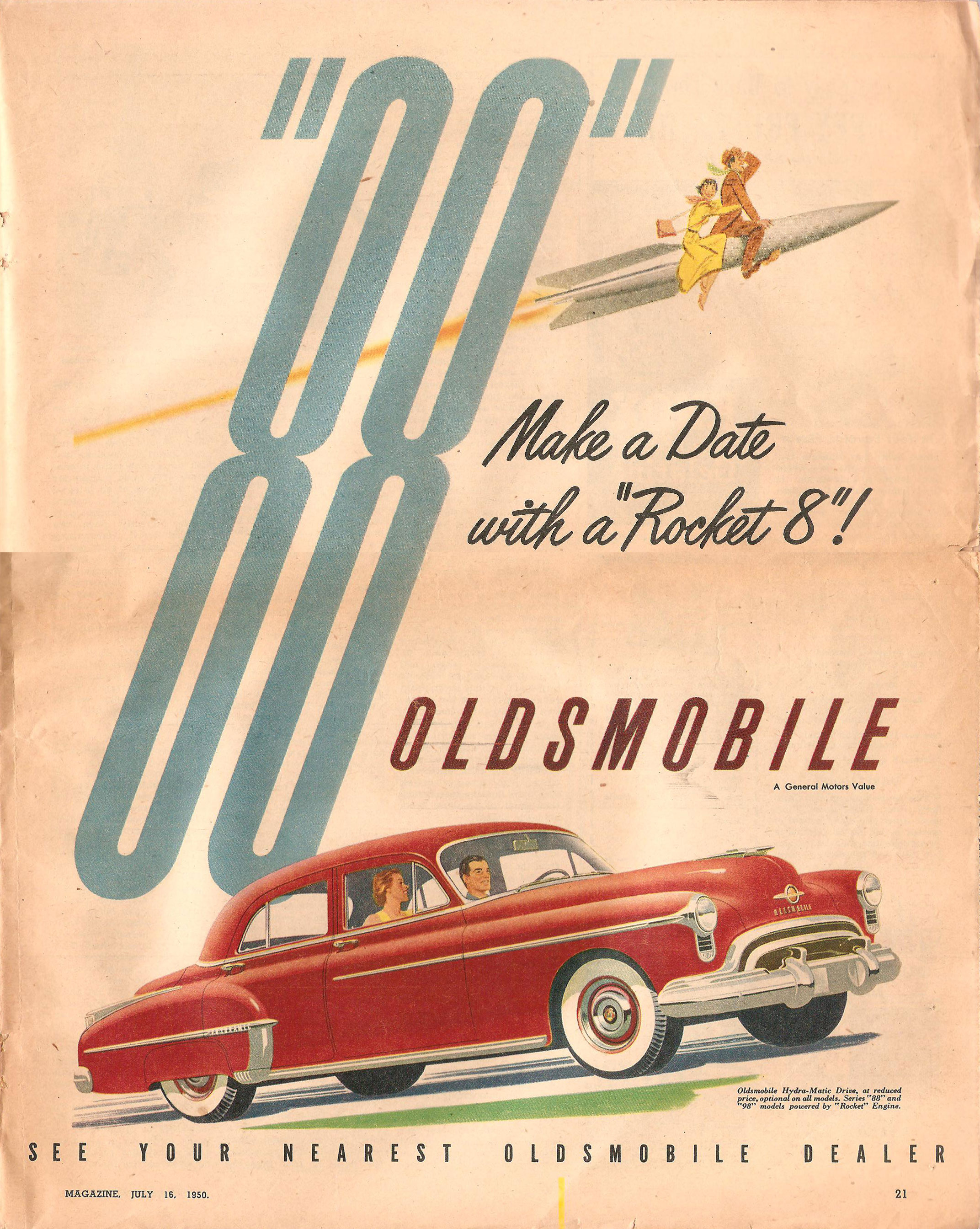
I want to make a date with an Olds 88

Posted by: Scott    Tags:  old newspapers    Posted date:  October 6, 2011  |  1 Comment


I think I found my dream car in the July 15, 1950 New York Times Magazine.

After all, as the ad says—it IS Hydra-Matic!

But if I can’t have the car … I at least want that rocket.

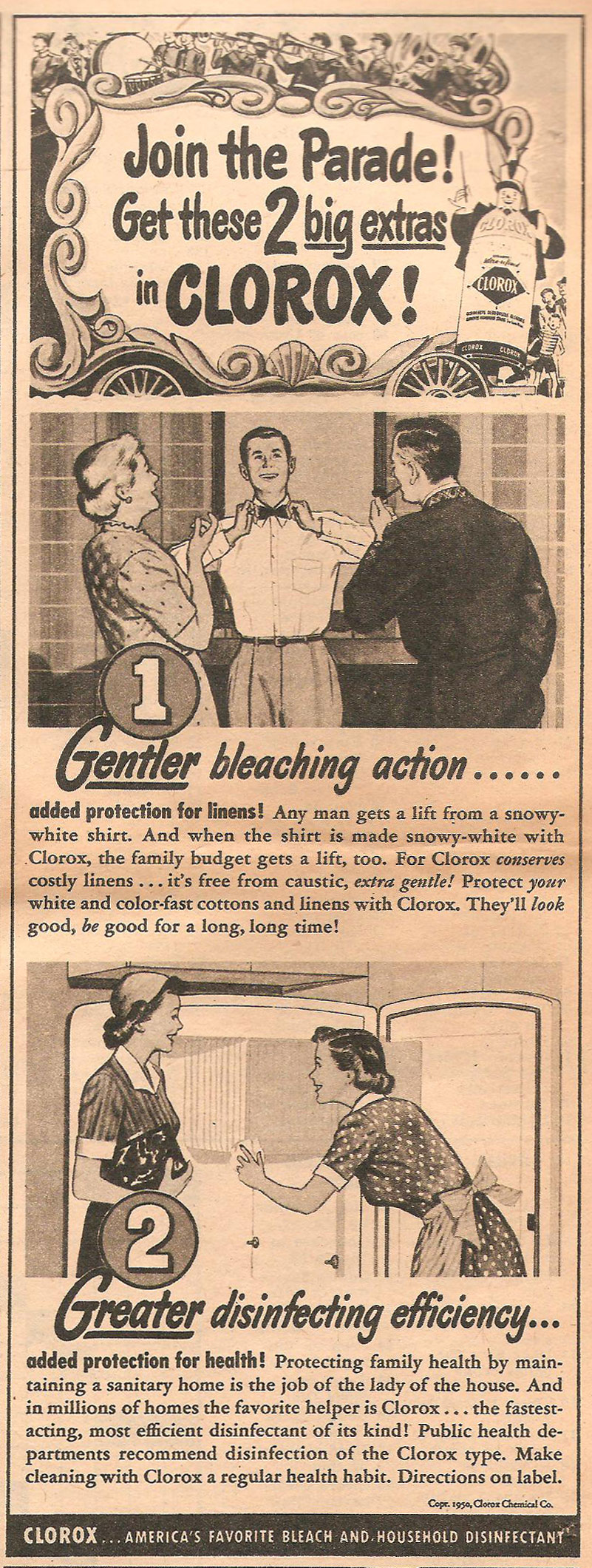
1950 Clorox ad drawn by … Jim Mooney?

Posted by: Scott    Tags:  comics, Jim Mooney, old newspapers    Posted date:  October 5, 2011  |  5 Comments


The following ad appeared in the July 16, 1950 issue of The New York Times Sunday Magazine. My wife, whose discerning eyes I’d trust more than anyone’s when it comes to the styles of DC artists of the ’50s and ’60s, swears both images are by Jim Mooney.

Mooney, for those not familiar with the name, was best known for drawing Supergirl from 1959-1968, though I also loved him on Dial H for Hero. On top of that, I was lucky enough to have him draw my fill-in issue of Omega the Unknown in 1977.

Give the Clorox ad below a look and let me know wherther your discerning eyes agree.

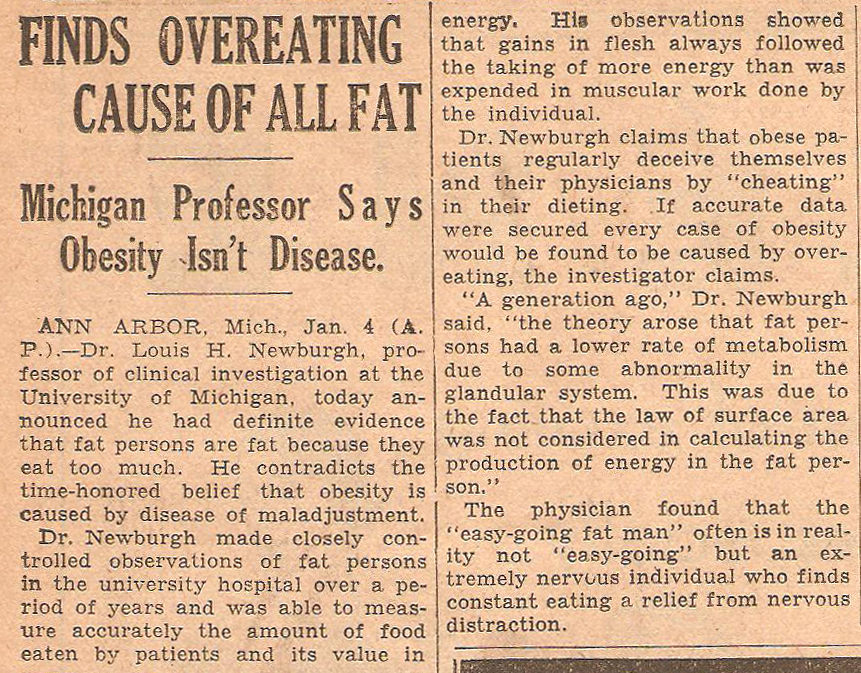
1930s study proves “fat persons are fat because they eat too much”

Posted by: Scott    Tags:  old newspapers    Posted date:  September 27, 2011  |  No comment


According to this Associated Press article from the mid-’30s, it turns out that “fat persons are fat because they eat too much” and “gains in flesh always followed the taking of more energy than was expended in muscular work by the individual.”

Wow … who knew?

Ain’t science amazing?

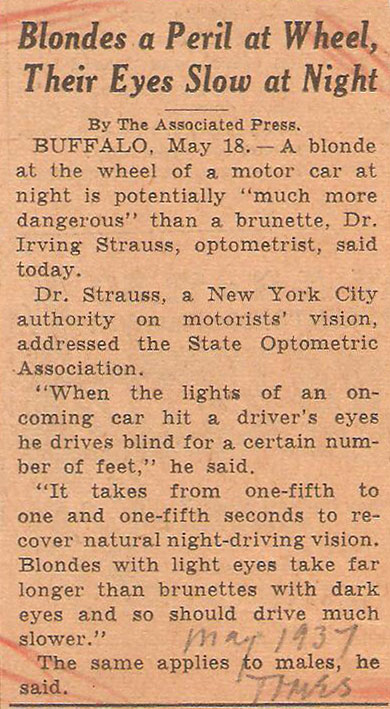
Optometrist says blonde drivers “much more dangerous” than brunettes

Posted by: Scott    Tags:  old newspapers    Posted date:  September 15, 2011  |  1 Comment


According to a May 1937 Associated Press article, blonde drivers are “much more dangerous” than brunettes, because:

When the lights of an oncoming car hit a driver’s eyes he drives blind for a certain number of feet. … It takes from one-fifth to one and one-fifth seconds to recover natural night-driving vision. Blondes with light eyes take far longer than brunettes with dark eyes and should drive much slower.

Since this 74-year-old article is the first time I’ve ever heard of this theory, I figure it’s safe to assume it was disproved a long time ago.

You’ll tell me if I’m wrong in that assumption, right?

The day I thought I met Bill Gallo

Posted by: Scott    Tags:  old newspapers    Posted date:  May 14, 2011  |  No comment


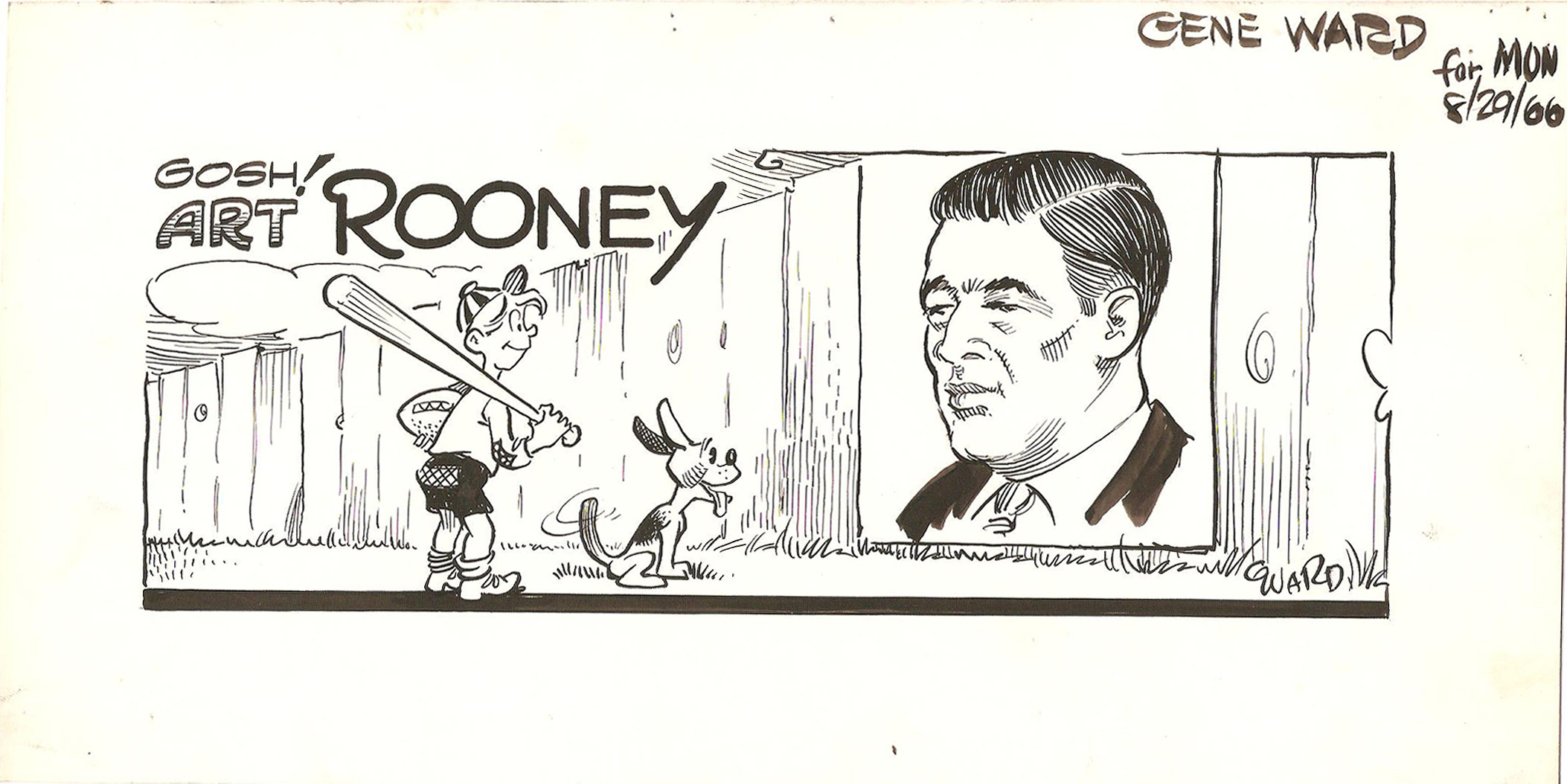
When the legendary Daily News sports cartoonist Bill Gallo died last week at age 88, I thought that was an opportunity to show you the drawing he gave me when I visited the paper in the early ’70s. Instead, it’s an opportunity show you that my memory’s not quite what I thought it was.

I didn’t have time to dig out my Bill Gallo drawing and scan it the day he died—it’s been a busy week—and when I pulled out my sports cartoon of Art Rooney, owner of the Pittsburgh Steelers, I noticed that—wait a second! It isn’t signed by Bill Gallo! It’s signed by Gene Ward. So I guess I’d remembered that childhood incident wrong.

But who’s Gene Ward?

I figured he must be a second string cartoonist who lived in Bill Gallo’s shadow at the Daily News, but when I started to do research, everything I could find tells me that Ward was a respected sports writer at the paper who, according to his obituary, covered 29 consecutive Kentucky Derbies. But nothing I could uncover showed that he was an artist as well. And yet … there’s his signature.

Which means … what?

That he was a columnist who drew cartoons for his own column? I find that difficult to believe, since someone somewhere online would have surely mentioned that.

That the piece was done by a staff artist at the Daily News who never got credit for his assignment because the writer hogged it all? I find that hard to believe, too, particularly since I’ve seen other art credited to Gene Ward for sale.

That this is really by Bill Gallo after all, as I first thought? The more I look at it, and compare it to other examples of Gallo’s art, the more I think that can’t be true either.

All I’m sure of is … I was handed this artwork at the Daily News by the artist himself … whoever that was.

So … who actually drew this piece? Who did I actually meet as a kid in the early ’70s? Looks like even though I thought I knew … I don’t.

Any ideas?

1911 NY Times article says science has killed mystery and romance

Posted by: Scott    Tags:  old newspapers    Posted date:  April 1, 2011  |  No comment


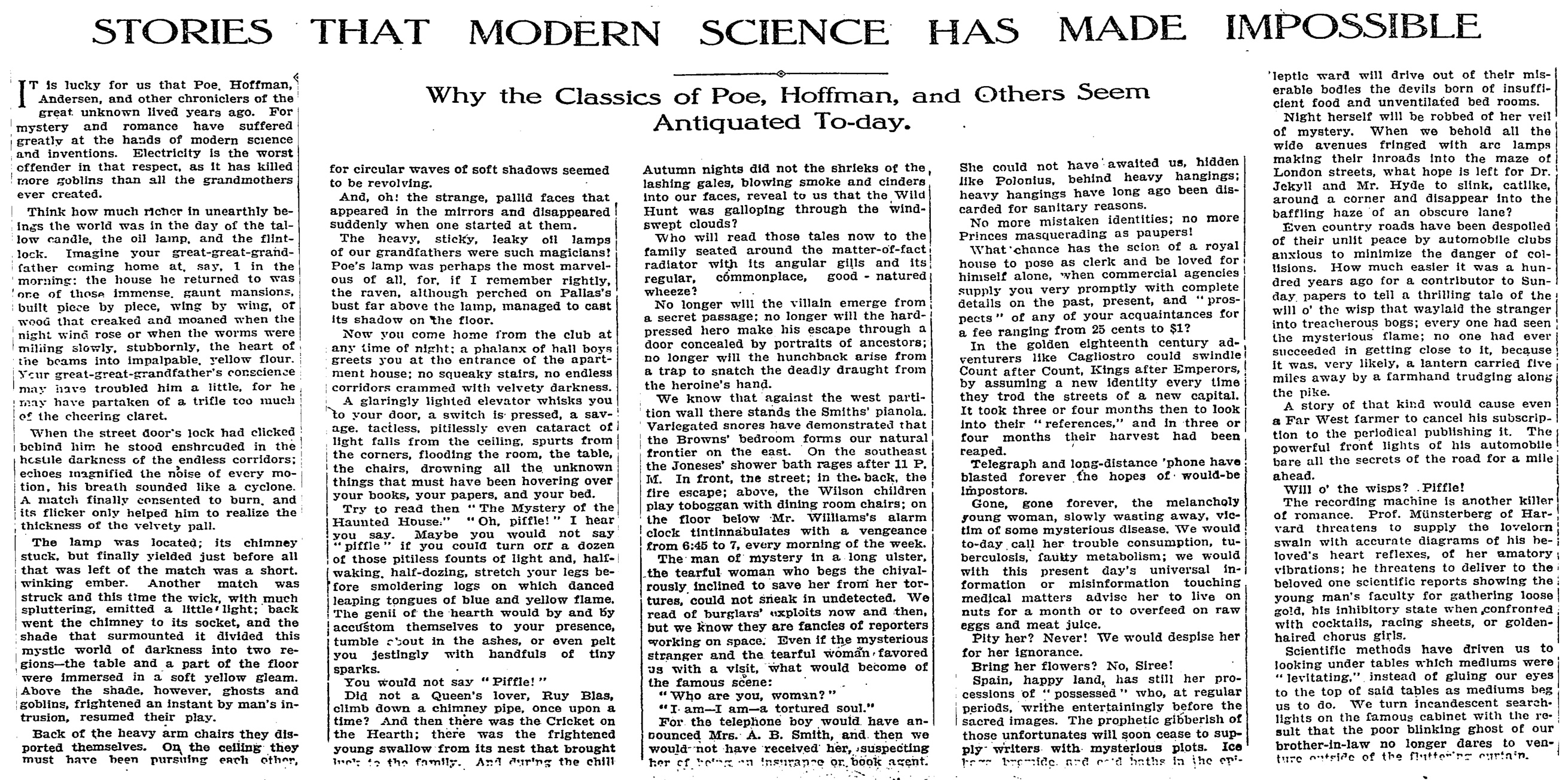
An unsigned essay in the March 26, 1911 edition of the New York Times bemoans the fact that “mystery and romance have suffered greatly at the hands of modern science and invention,” and that the world therefore no longer has a place for such writers as Edgar Allan Poe, E. T. A. Hoffmann, and Hans Christian Andersen, who supposedly found it much easier to blow our minds in the good old pre-1911 days.

The writer is afraid that without, to use one example, the shadows cast by “heavy, sticky, leaky oil lamps,” and with instead “a savage, tactless, pitilessly even cataract of light”:

“Who will read those tales now to the family seated around the matter-of-fact radiator with its angular gills and its regular, commonplace, good-natured wheeze?”

Luckily, we have somehow gotten by, and still find things that frighten us, even though we’ve advanced quite a bit beyond the science and invention of 100 years ago.

What I found the most interesting in the piece, though, was that the writer complained about the lack of anonymity and the loss of the ability for people to reinvent themselves back then—and he or she wasn’t talking about it being caused by the Internet, but instead by a couple of far simpler technologies.

“What chance has the scion of a royal house to pose as clerk and be loved for himself alone, when commercial agencies supply you very promptly with complete details on the past, present, and ‘prospects’ of any of your acquaintances for a fee ranging from 25 cents to $1? … Telegraph and long-distance phone have blasted forever the hopes of would-be impostors.”

Which tells me that come 2111, when we’ve slid even further along that slippery technology slope, our descendants will look back on quaint 2011 and wonder how you and I didn’t realize how how good we really had it.

The ecstasy of the Agony Column of The Times: 1800-1870

Posted by: Scott    Tags:  old books, old newspapers    Posted date:  February 5, 2011  |  No comment


I wish I could remember courtesy of whose Twitter feed I found out about the 1881 book, The Agony Column of The Times: 1800-1870, because I’m finding it fascinating, and am very grateful.

The book (which I downloaded here) is filled with evidence of how little we’ve changed over the centuries, how people are filled with love and longing and loss (and hope, too!) whatever the year.

I’ve always enjoyed reading classified ads detailing missed connections of those who smiled at each other on the subway, passed in a supermarket, nodded in the street, and then went on, with no word spoken, and nothing exchanged but a dream that enflamed a regret. And so they placed an ad describing the encounter, hoping their possible future could be found.

All such ads I’d seen up until now have been contemporary, but here’s an example from just over 210 years ago.

A Gentlemen wrote to a Lady on December, 18, 1800:

If the lady who a Gentleman handed into her carriage from Covent Garden Theater, on Wednesday, the third of this month, will oblige the Advertiser with a line to Z. Z., Spring Garden Coffee House, saying if married or single, she will quiet the mind of a young Nobleman, who has tried, but in vain, to find the Lady. The carriage was ordered to Bond Street. The Lady may depend on honour and secrecy. Nothing but the most honourable interview is intended. The Lady was in mourning, and sufficiently cloathed to distinguish her for possessing every virtue and charm that man could desire in a female that he would make choice of for a Wife. Deception will be detected, as the Lady’s person can never be forgot.

Did he find her? Did she answer? And if she did answer, how did it go? We’ll never know, unless as I move forward through the book, I discover a follow-up notice.

Such poignancy can be beautiful. And heartbreaking.

As heartbreaking as stories without endings.

  • Follow Scott


  • Twitter Updates

    • Latest Photos


    • Search

    • Tags

      Ad Astra anniversary Balticon Bill Mantlo Brooklyn comics conventions DC Comics dreams food George Formby Gerry Conway Gil Kane horror Irene Vartanoff Jack Kirby Jim Shooter Man v. Food Marie Severin Marvel Comics My Father my writing Nebula Awards obituaries old magazines old newspapers Paul Levitz Peru Readercon rejection slips San Diego Comic-Con Scarecrow science fiction Science Fiction Age Sharon Moody Spider-Man Stan Lee Stoker Awards Superman ukulele Video Worldcon World Fantasy Convention World Horror Convention zombies